Many buyers use NPT fittings daily but do not fully understand how they seal. This gap often causes leaks, cracked ports, and warranty claims.
NPT fittings are tapered pipe thread connections defined by ASME B1.20.1 that seal through metal-to-metal interference created by a 1:16 taper and a 60° thread angle.
If you source hydraulic adapters or hose fittings for the U.S. market, you must understand NPT beyond the catalog description. I will explain it from engineering and field perspectives.
What Does NPT Stand For?
Many people repeat the term NPT but cannot explain what it truly means. This leads to confusion between NPT, NPTF, and NPS.
NPT stands for National Pipe Taper. It is a U.S. standard tapered thread defined by ASME B1.20.1 for pressure-tight pipe connections.
Definition of National Pipe Taper
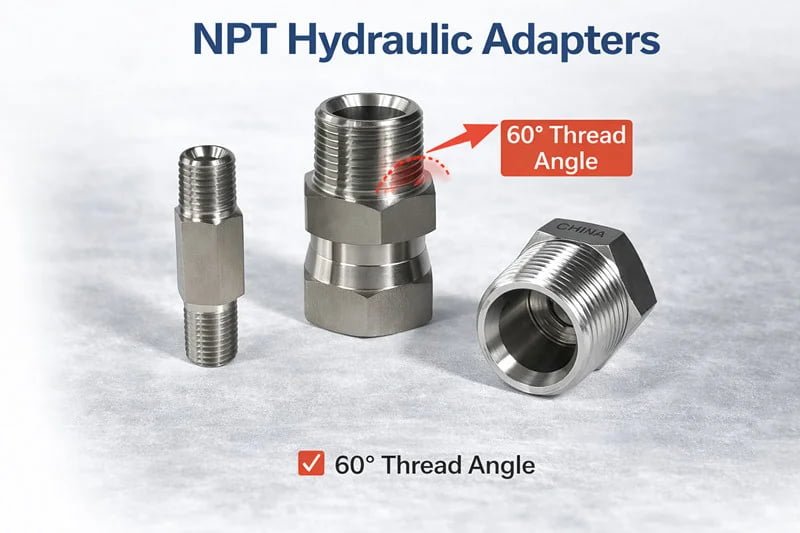
National Pipe Taper means the threads are cut on a 1:16 taper. The diameter reduces gradually along the thread length. This taper allows the male and female threads to wedge together as they tighten.
This wedging effect creates sealing pressure.
Governing Standards (ASME B1.20.1)
The geometry of NPT threads is controlled by ASME B1.20.1. The standard defines:
- Thread angle (60°)
- Taper rate (1:16)
- Thread pitch
- Crest and root dimensions
- Engagement length
If the thread does not meet this standard, sealing performance becomes unpredictable.
Why NPT Became U.S. Standard
The U.S. industrial system adopted NPT early in oil, gas, and hydraulic development. Over time, it became dominant in North America.
Today, if you supply stainless steel hydraulic adapters into the U.S., you will face NPT demand daily.
How NPT Threads Work
Many articles stop at definitions. I prefer to explain the physics behind it.
NPT works by creating radial compressive stress between tapered male and female threads as tightening increases interference.
60-Degree Thread Angle Explained
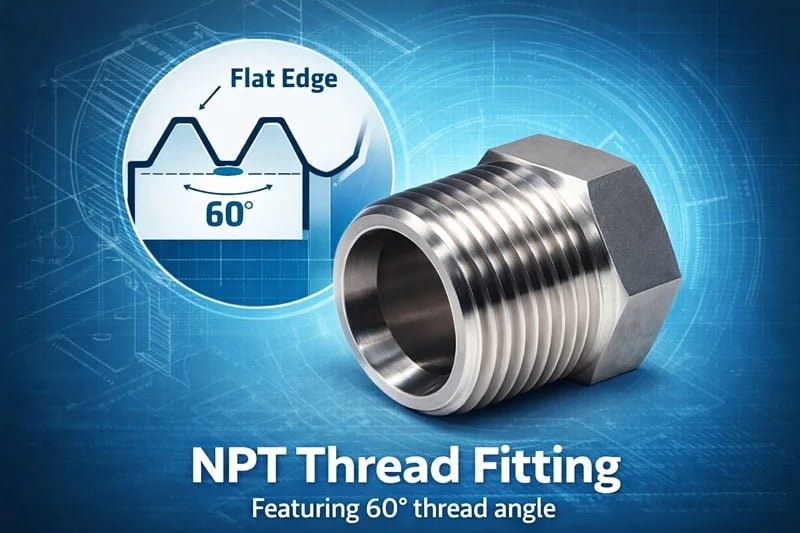
NPT uses a 60° thread angle. This angle distributes axial tightening force into radial force.
When you apply torque, the inclined thread flanks push outward. That outward force generates contact pressure.
NPT Thread Size Chart
NPT size refers to nominal pipe size, not the actual outside thread diameter. Always verify thread pitch and major diameter together.
Below is a practical reference chart for standard NPT thread sizes:
| Nominal Pipe Size | Threads Per Inch (TPI) | Approx. Major OD (inch) | Approx. Major OD (mm) |
|---|---|---|---|
| 1/16" | 27 | 0.3125 | 7.94 mm |
| 1/8" | 27 | 0.405 | 10.29 mm |
| 1/4" | 18 | 0.540 | 13.72 mm |
| 3/8" | 18 | 0.675 | 17.15 mm |
| 1/2" | 14 | 0.840 | 21.34 mm |
| 3/4" | 14 | 1.050 | 26.67 mm |
| 1" | 11.5 | 1.315 | 33.40 mm |
| 1-1/4" | 11.5 | 1.660 | 42.16 mm |
| 1-1/2" | 11.5 | 1.900 | 48.26 mm |
| 2" | 11.5 | 2.375 | 60.33 mm |
1:16 Taper Design and Interference Sealing
The 1:16 taper means the diameter changes 1 unit for every 16 units of length.
As you tighten:
- Thread contact area increases
- Radial interference increases
- Friction increases
- Sealing force increases
The taper transforms rotation into compression.
How the Seal Is Created (Metal-to-Metal Compression)
The sealing mechanism depends on:
- Axial torque
- Thread flank contact
- Radial expansion of female port
- Elastic deformation of material
The male thread wedges into the female thread. This creates:
- Radial pressure
- Micro deformation
- Restricted leak paths
If the material is too soft, deformation becomes permanent. If too hard, sealing may be incomplete.
Why Thread Sealant Is Still Required
Many engineers ask me this question.
Even though NPT is interference-based, microscopic spiral leak paths still exist along the thread helix.
Sealant fills:
- Surface roughness
- Manufacturing tolerance gaps
- Spiral clearances
Without sealant, small gas leaks often appear.
NPT vs Other Pipe Threads
Buyers often confuse NPT with other standards. This mistake creates serious compatibility issues.
NPT is tapered and American standard. It is not directly interchangeable with NPS, BSPT, or SAE straight threads.
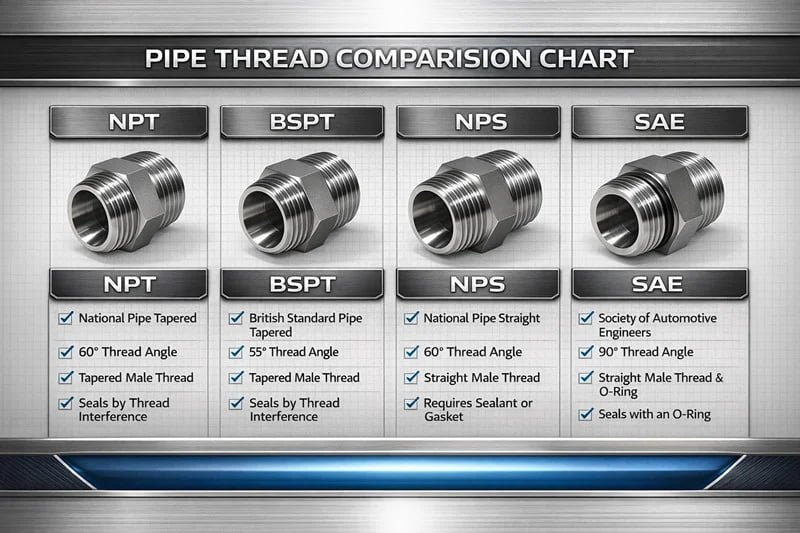
NPT vs NPS (Tapered vs Straight)
- NPT = tapered
- NPS = straight
NPS requires gasket or O-ring sealing. It does not seal by thread interference.
NPT vs BSPT (American vs British Standard)
Both are tapered. But:
- NPT thread angle = 60°
- BSPT thread angle = 55°
The pitch and form differ. They may screw together partially, but sealing is unreliable.
NPT vs SAE (Hydraulic Systems)
SAE straight thread (like ORB) seals via O-ring. The thread only provides clamping force.
These systems are structurally different from tapered sealing.
NPT vs NPTF
Many buyers assume NPT and NPTF are identical. That assumption can create sealing or inspection confusion.
NPTF stands for National Pipe Taper Fuel. It is a modified dry-seal version of NPT designed to seal without sealant under controlled conditions.
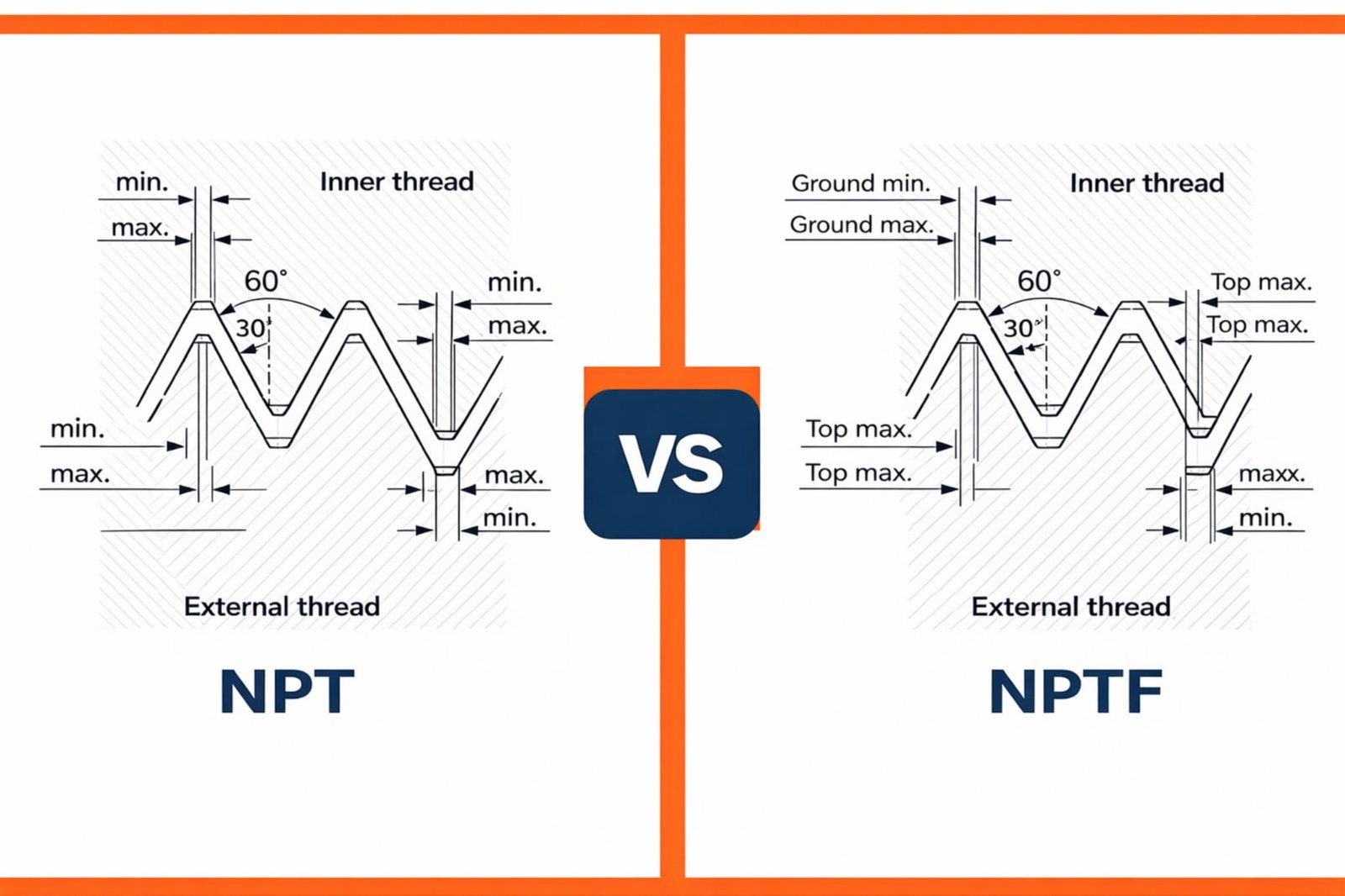
Key Engineering Differences
Although both share:
- 60° thread angle
- 1:16 taper
- Same pitch
The difference lies in crest and root truncation.
NPTF has controlled crest and root dimensions. When assembled, the thread roots and crests interfere tightly. This minimizes spiral leak paths.
Standard NPT leaves small clearance at crest and root. That clearance usually requires sealant.
Dry Seal Theory vs Field Reality
In theory, NPTF can seal metal-to-metal without sealant.
In practice, I still recommend sealant because:
- Surface finish varies
- Installation torque varies
- Field damage is common
- Stainless steel machining tolerances differ
For hydraulic systems, especially in stainless steel, sealant adds safety margin.
Inspection Differences
NPT and NPTF require different gauges.
If your supplier claims NPTF, they must verify using proper L1 and L3 gauges.
For OEM export projects, I always confirm the exact thread specification in purchase orders to avoid shipment disputes.
Compatibility and Interchangeability Risks
Here is a simplified comparison:
| Thread Type | Tapered | Thread Angle | Sealant Required | Interchangeable with NPT? |
|---|---|---|---|---|
| NPT | Yes | 60° | Yes | — |
| NPTF | Yes | 60° | Not theoretically | Generally compatible |
| NPS | No | 60° | Yes | No |
| BSPT | Yes | 55° | Yes | Not recommended |
I always tell buyers: if you are not 100% sure, do not mix.
How to Identify an NPT Fitting
Wrong identification causes field failures.
You can identify NPT by checking taper, measuring pitch, and verifying thread angle with proper gauges.
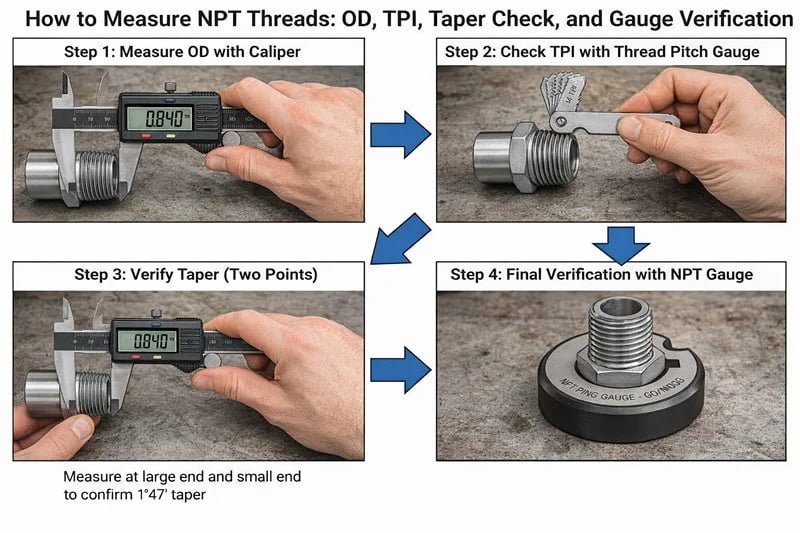
Visual Characteristics
- Visible taper
- Flattened crest
- 60° thread profile
- Decreasing diameter toward end
Measuring Thread Pitch
Use a thread pitch gauge.
Common NPT threads:
- 1/8-27
- 1/4-18
- 3/8-18
- 1/2-14
If pitch does not match, it is not NPT.
Using Thread Gauges
A proper NPT L1 gauge verifies:
- Correct engagement depth
- Thread accuracy
- Conformity to standard
Professional OEM buyers always require gauge inspection reports.
Taper Detection Method
Use calipers:
- Measure diameter at first thread.
- Measure diameter several threads back.
- Compare difference.
If diameter decreases gradually, it is tapered.
Proper Installation of NPT Fittings
Most NPT failures come from installation mistakes.
Correct NPT installation is finger tight plus 2–3 turns with sealant, without exceeding material limits.
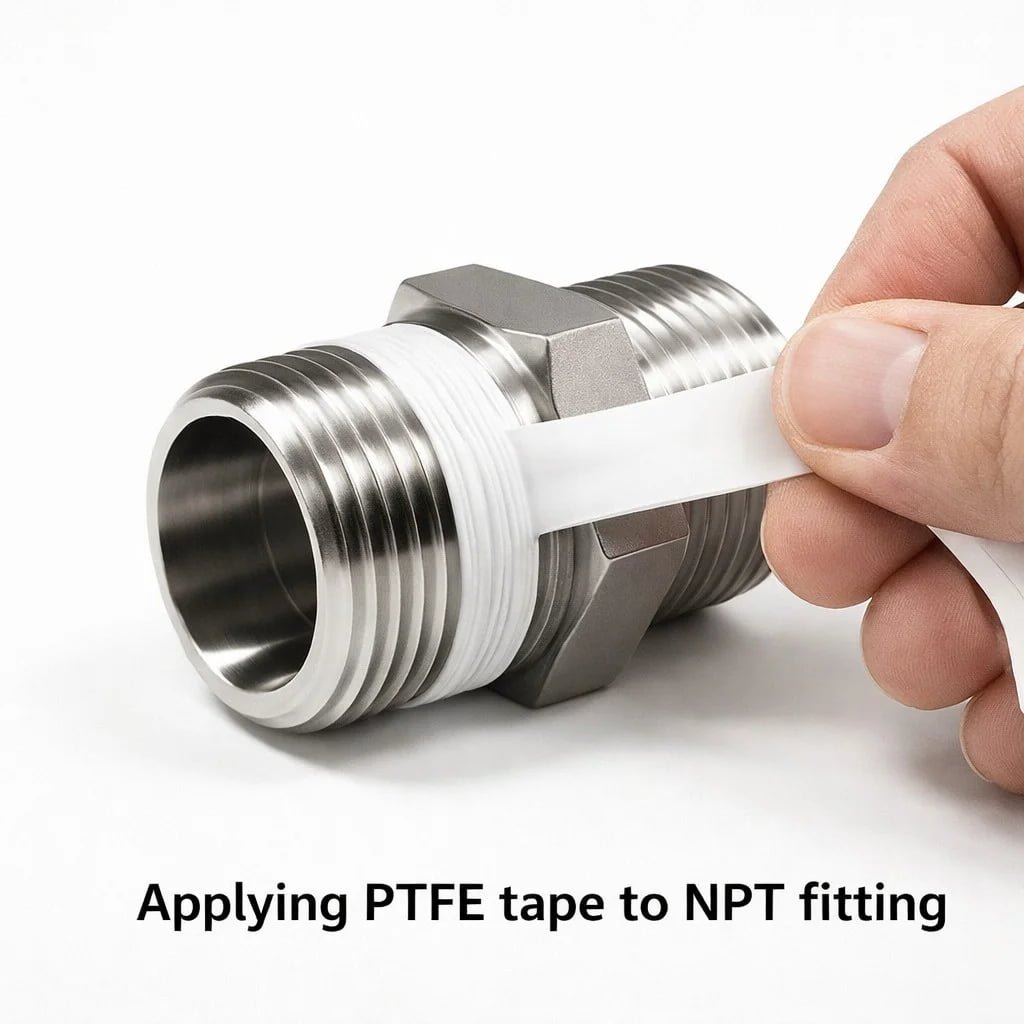
Step-by-Step Installation Guide
- Inspect threads.
- Clean debris.
- Apply PTFE tape or pipe dope.
- Tighten finger tight.
- Use wrench for additional 2–3 turns.
I always advise: stop when resistance increases sharply.
PTFE Tape vs Pipe Dope
PTFE tape:
- Cleaner
- Easy for field service
Pipe dope:
- Better for vibration
- Better for gas sealing
Torque Guidelines
There is no universal torque because:
- Material differs
- Port thickness differs
- Lubrication differs
Soft materials like aluminum require caution.
Avoiding Over-Tightening
Over-tightening causes:
- Split female ports
- Distorted threads
- Permanent deformation
In stainless steel, over-tightening increases galling risk. I always recommend anti-seize for stainless NPT.
Common NPT Problems and How to Fix Them
Many long-tail searches come from troubleshooting.
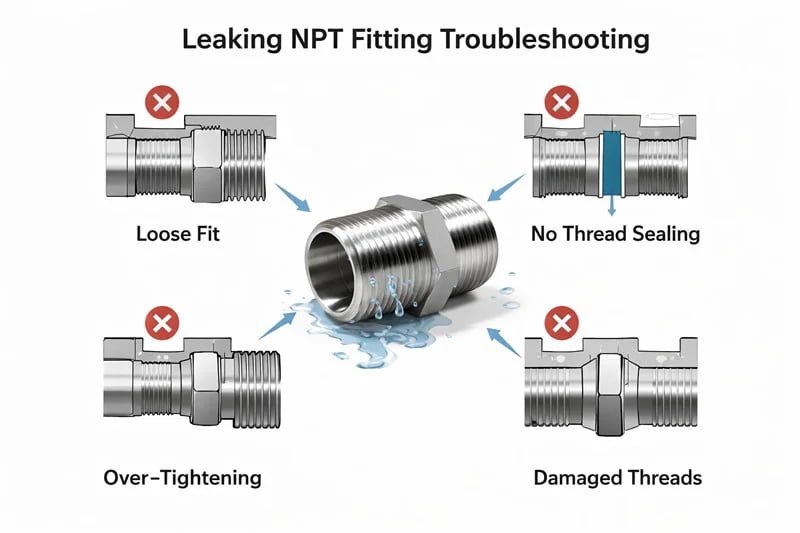
Most NPT failures result from improper torque, damaged threads, or wrong thread combination.
Why NPT Fittings Leak
Causes:
- Insufficient turns
- No sealant
- Damaged crest
- Mixed standards
Fix:
- Reinspect
- Clean
- Reapply sealant
- Replace damaged part
Cross-Threading
Cross-threading happens when alignment is poor.
Prevention:
- Always start by hand
- Never force first turn
Galling in Stainless Steel
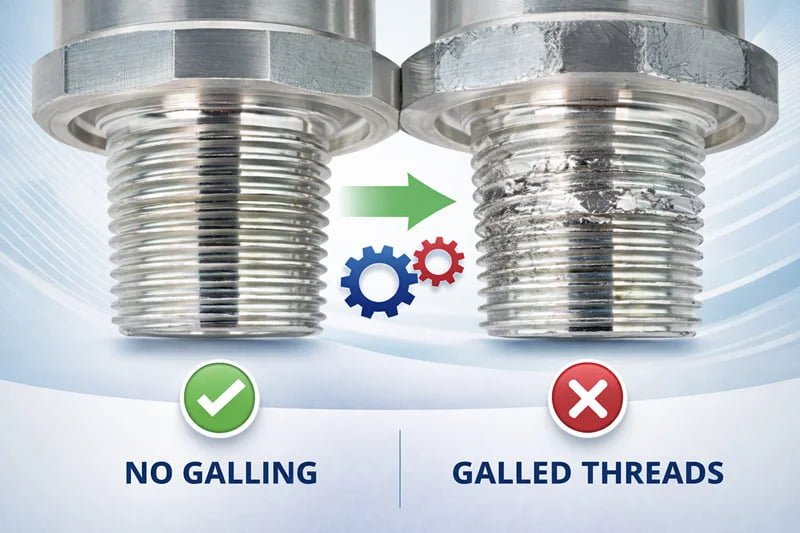
Stainless steel under pressure creates adhesive wear.
Prevention:
- Use lubrication
- Avoid dry assembly
- Do not rush installation
Cracked Female Ports
Often caused by:
- Over-tightening
- Thin wall casting
- Poor machining
This problem is common in aluminum manifolds.
Pressure Ratings and Application Limits
Many buyers think NPT size equals pressure rating. That is incorrect.
Thread type does not determine pressure rating. Material, wall thickness, and design do.
| NPT Size | Typical Working Pressure (Carbon Steel) | Typical Working Pressure (Stainless Steel 316) |
|---|---|---|
| 1/8" | 6,000–10,000 psi | 6,000–8,000 psi |
| 1/4" | 6,000–9,000 psi | 5,000–7,500 psi |
| 3/8" | 5,000–8,000 psi | 4,000–6,000 psi |
| 1/2" | 4,000–6,000 psi | 3,500–5,000 psi |
| 3/4" | 3,000–5,000 psi | 3,000–4,500 psi |
| 1" | 2,000–4,000 psi | 2,000–3,500 psi |
| 1-1/4" | 1,500–3,000 psi | 1,500–2,500 psi |
| 1-1/2" | 1,000–2,500 psi | 1,000–2,000 psi |
| 2" | 800–2,000 psi | 800–1,500 psi |
Why Thread Type Does Not Equal Pressure Rating
1/4 NPT in brass is different from 1/4 NPT in stainless steel.
Pressure capacity depends on:
- Material yield strength
- Engagement length
- Port design
Material Impact
- Brass = lower strength
- Carbon steel = high strength
- Stainless 316L = corrosion resistant
Material choice changes pressure capability significantly.
Temperature Considerations
High temperature reduces yield strength.
Sealant performance also changes with temperature.
When to Use (and Not Use) NPT Fittings
Not every hydraulic system should use NPT.
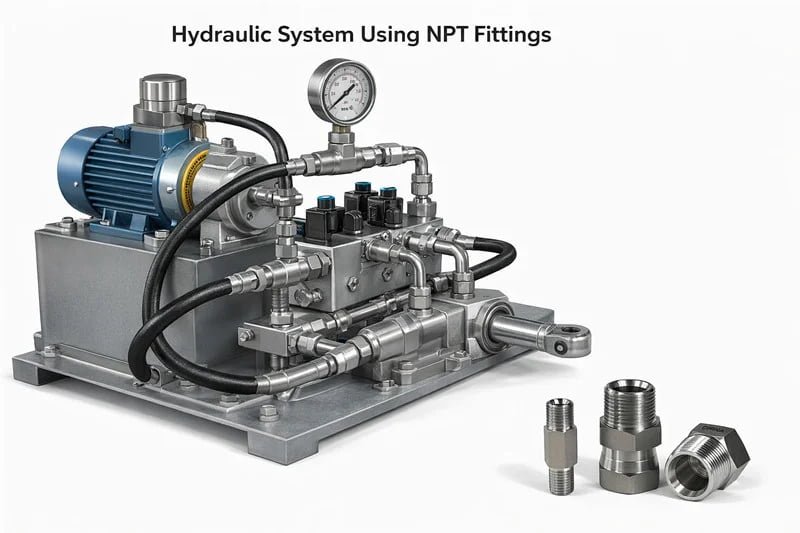
NPT is suitable for general hydraulic and low-to-medium pressure systems but not ideal for high-vibration or repeated assembly applications.
Hydraulic Systems
NPT works in many standard hydraulic applications, especially in North America.
High-Vibration Environments
Taper threads can loosen under vibration. ORFS may perform better.
Gas vs Liquid Applications
Gas requires perfect sealing. Sealant quality becomes critical.
Frequently Asked Questions About NPT Fittings
Many customers ask these questions repeatedly.
Clear answers prevent costly sourcing mistakes.
Are NPT fittings reusable?
Yes, but inspect threads carefully. Replace if crest damage or deformation appears.
Can NPT connect to BSP?
It may partially engage, but I do not recommend it. Sealing reliability is poor.
Do all NPT fittings require sealant?
In most practical applications, yes.
Is NPT the same as IPT or FPT?
IPT and FPT are older naming terms often referring to the same tapered pipe thread family.
Conclusion
NPT is simple in appearance but complex in physics. If you understand its mechanics, installation, and limits, you reduce failures and protect your hydraulic system.
TITAN Fluid is a leading supplier of stainless steel NPT Fittings for over 15 years. Download a NPT Fittings Catalog.