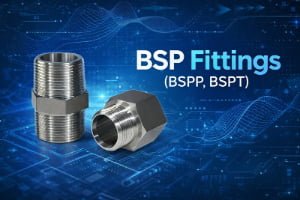
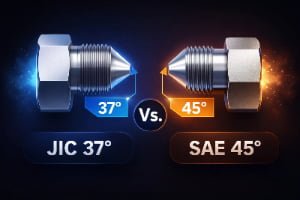
Wrong thread standards cause leaks, downtime, and rework. Buyers lose money because BSP is misunderstood, not because it is complex.
BSP fittings are pipe fittings based on British Standard Pipe threads, using a 55° thread form, available in parallel (BSPP) and tapered (BSPT) versions, with defined sealing methods.
I have worked with BSP fittings for over 15 years. Problems never come from BSP itself. They come from wrong matching and wrong sealing logic.
What Are BSP Fittings?
Global sourcing creates confusion. Many buyers assume all pipe threads behave the same, but BSP works by its own rules.
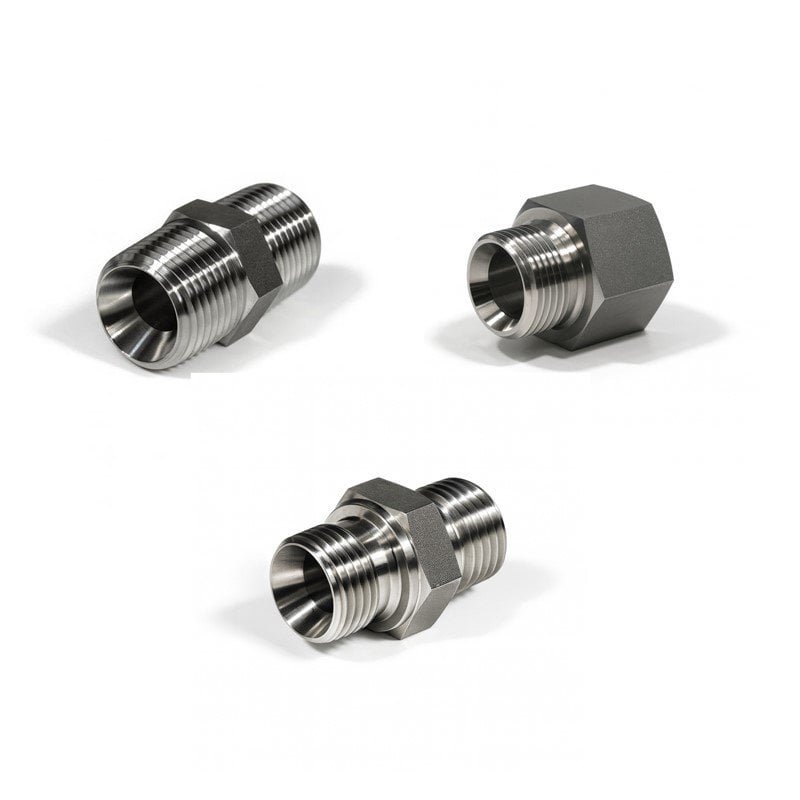
BSP fittings are connectors that follow British Standard Pipe specifications, including thread angle, pitch, tolerance, and sealing method.
Definition of BSP fittings
I treat BSP fittings as a system. The thread alone does not define performance. Geometry, sealing, and torque all matter.
Origin of the British Standard Pipe system
The BSP system originated in the UK during early industrial manufacturing. It was designed to standardize pipe connections across suppliers.
Why BSP is still widely used globally
BSP remains common in Europe, Asia, Australia, and Africa. Entire supply chains and machines were built around it, so it continues to be used today.
Understanding BSP Thread Standards?
Thread standards look simple, but geometry creates most failures.
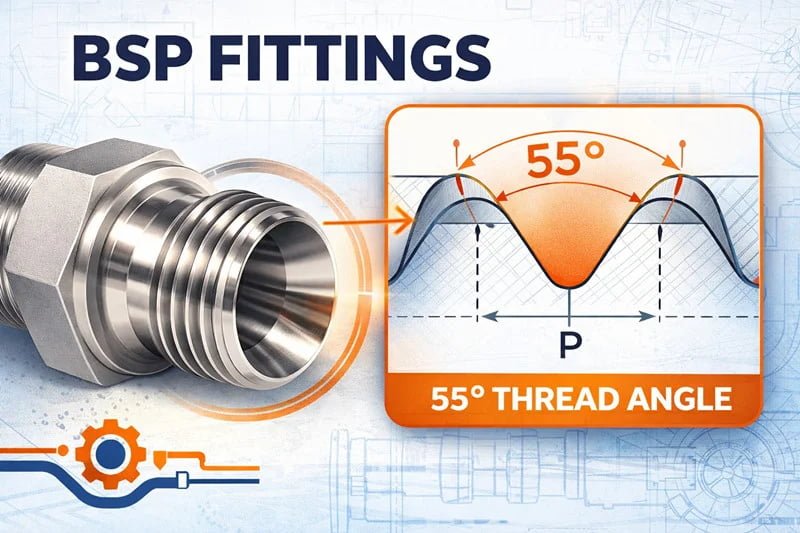
BSP threads use a 55° Whitworth profile with fixed pitch rules, making them incompatible with other pipe threads.
What Does “BSP” Stand For?
BSP means British Standard Pipe. It does not describe pressure rating or sealing by itself.
BSP Thread Angle and Geometry (55° Explained)
The 55° angle with rounded crests spreads load differently than 60° threads. Mixing angles damages threads quickly.
Parallel vs Tapered Threads – Why It Matters
Parallel threads do not seal on the threads. Tapered threads do. Confusing these two causes leaks.
BSPP vs BSPT — Key Differences Explained?
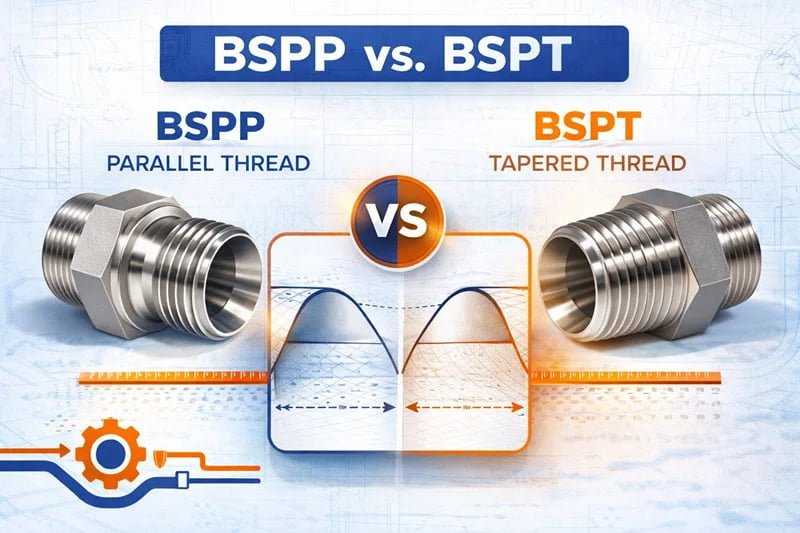
Many buyers choose based on stock availability. That decision creates risk.
BSPP seals with external seals, while BSPT seals through thread interference using sealant.
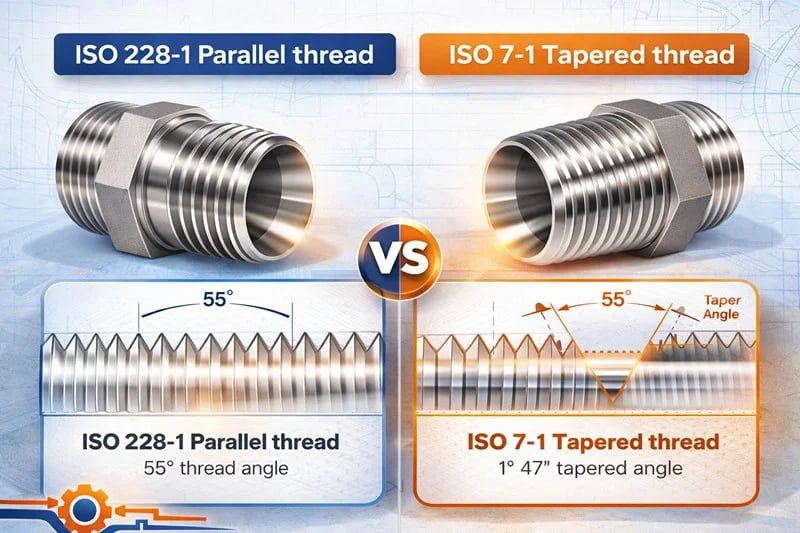
What Is BSPP (Parallel Thread)?
BSPP threads are straight and provide mechanical holding only.
How sealing works
Sealing is achieved by O-rings, bonded seals, or washers at the face or shoulder.
Typical applications
BSPP is common in hydraulics, adapters, and manifolds where repeat assembly matters.
What Is BSPT (Tapered Thread)?
BSPT threads are tapered and seal through tightening.
Thread interference sealing
As the thread tightens, interference creates the seal.
Use of thread sealant or PTFE tape
Sealant fills micro gaps and prevents spiral leaks.
BSPP vs BSPT Comparison Table
| Feature | BSPP | BSPT |
|---|---|---|
| Thread type | Parallel | Tapered |
| Sealing method | O-ring or washer | Thread interference |
| Reusability | High | Limited |
| Torque sensitivity | Medium | High |
BSP vs NPT vs Metric Threads?
Mixing standards is one of the most expensive beginner mistakes.
BSP, NPT, and metric threads differ in angle, pitch, and sealing logic, so they are not interchangeable.
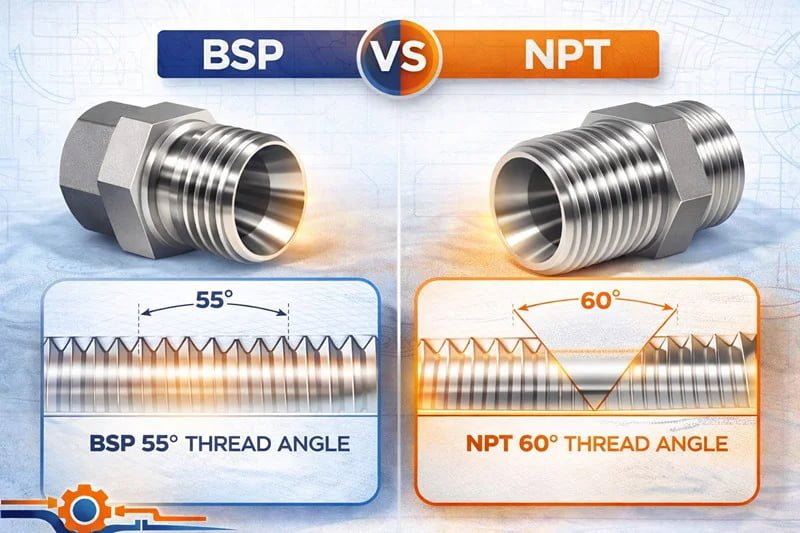
BSP vs NPT — Why They Are Not Interchangeable
BSP uses 55°. NPT uses 60°. Pitch and sealing behavior are different.
BSP vs Metric Threads (ISO Standards)
Metric threads use millimeter pitch and usually seal with O-rings or faces, not threads.
Regional Usage (UK, Europe, Asia, US)
Europe and Asia mainly use BSP. The US mainly uses NPT. OEM equipment often mixes standards.
How to Identify BSP Threads Correctly?
Guessing costs more than measuring.
Correct BSP identification requires measuring diameter, pitch, and thread type.
Measuring Thread Size and Pitch
I always use calipers and pitch gauges. Nominal names are misleading.
Common Identification Mistakes
Assuming taper from tightening feel is a common error.
Tools and Gauges Engineers Use
Thread gauges and reference fittings remove uncertainty.
Common Applications of BSP Fittings?
BSP is used because it works when applied correctly.
BSP fittings are widely used in hydraulics, pneumatics, industrial machinery, and fluid transfer systems.
Data Center Cooling
In data center liquid cooling systems, BSPP fittings are increasingly common, especially in direct-to-chip and rack-level cooling loops. Parallel threads with O-ring sealing reduce leak risk and allow controlled torque during installation.
Hydraulics
BSPP with O-ring sealing handles pressure spikes well.
Pneumatics
BSPT is common in air systems with sealant.
Oil & gas
Used mainly in auxiliary and support systems.
Industrial machinery
European machines often standardize on BSP.
Plumbing and fluid transfer
Many regions still use BSP due to legacy infrastructure.
Common Problems and FAQs?
BSP problems are almost always human errors.
Most BSP leaks come from wrong matching, wrong seals, or wrong torque.
Can BSP and NPT Be Connected?
They should not be connected. Damage starts immediately.
Why Do BSP Fittings Leak?
Missing seals, damaged faces, or wrong sealing logic cause leaks.
How to Seal BSP Threads Properly
Match BSPP with proper seals and BSPT with sealant and correct torque.
How to Choose the Right BSP Fitting?
Choosing correctly saves more money than negotiating price.
The right BSP fitting is chosen based on material, pressure, temperature, and sealing method.
Material considerations
I select SS304 or SS316L based on corrosion and media.
Pressure and temperature
Temperature affects elastomer seals and torque behavior.
Sealing method selection
I always decide sealing first, then choose thread type.
TITAN Fluid is a leading supplier of stainless steel BSP fittins for over 15 years. Download a BSP Fittings Catalog.