Many buyers confuse NPSM and NPT threads. That confusion causes leaks, warranty claims, and angry end users.
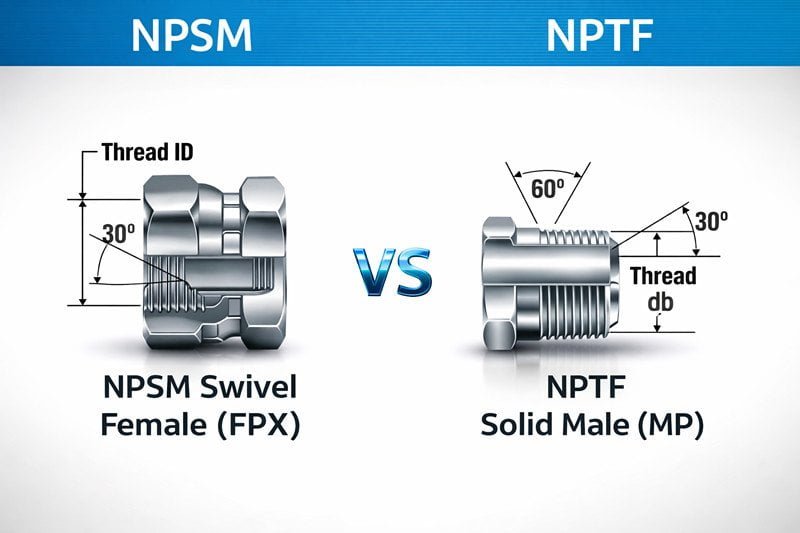
NPT uses tapered threads to seal by interference fit, while NPSM uses straight threads and seals with a gasket or cone seat.
I have seen too many costly mistakes caused by assuming “pipe thread is pipe thread.” Let me break this down clearly, from an engineering and buyer perspective.
What Is NPT (National Pipe Tapered Thread)?
Many engineers assume NPT seals because it is tight. That assumption is only half true and often dangerous.
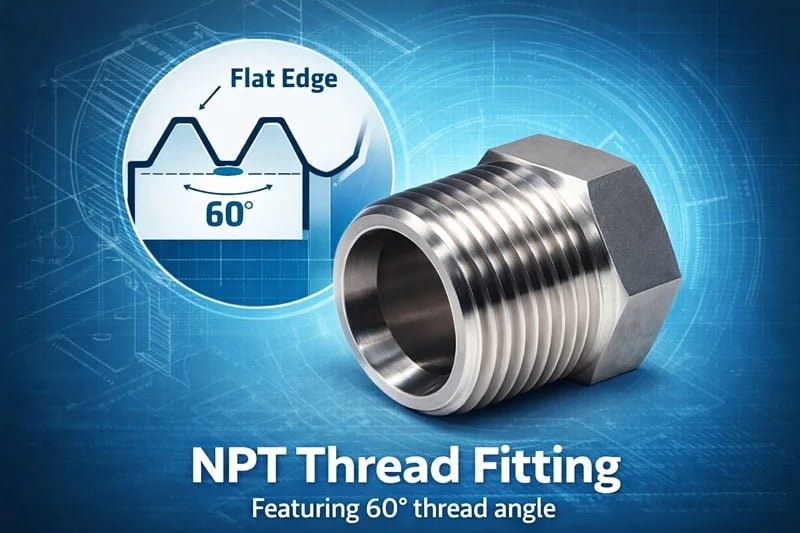
NPT is a tapered pipe thread defined by ANSI/ASME standards, using a 1° 47′ 24″ taper to create an interference fit that forms a pressure seal when properly installed with sealant.
Tapered Thread Design Explained
NPT threads have a taper angle of 1° 47′ 24″ from the centerline, or 1 in 16 on diameter. That means the diameter decreases as the thread moves inward.
This geometry creates radial compression when the male and female threads engage.
How interference fit works
When you tighten an NPT fitting:
- The male thread wedges into the female thread.
- The thread flanks contact progressively.
- Radial pressure builds outward.
- Micro gaps reduce as torque increases.
The seal is created by metal-to-metal flank contact, not by the thread crest or root.
However, the threads alone do not create a perfect seal. Small spiral leak paths remain between thread roots and crests. That is why NPT requires sealant.
How NPT Seals
NPT sealing happens through:
- Mechanical wedging
- Radial deformation
- Sealant filling micro-voids
Without PTFE tape or liquid sealant:
- Spiral leakage paths remain
- Micro-leaks occur under pressure cycling
- Vibration worsens leakage
Common Applications of NPT Fittings
I typically see NPT used in:
- Hydraulic power units
- Pneumatic systems
- Fuel transfer lines
- Industrial washdown systems
In our stainless hydraulic hose fittings catalog, many NPTF/NPT threaded hose ends are used in North American markets because installers are familiar with them.
NPT is common because it is simple, but it is not always the best choice for high-vibration systems.
What Is NPSM (National Pipe Straight Mechanical Thread)?
Many buyers think NPSM is just a “non-taper NPT.” That is incorrect.
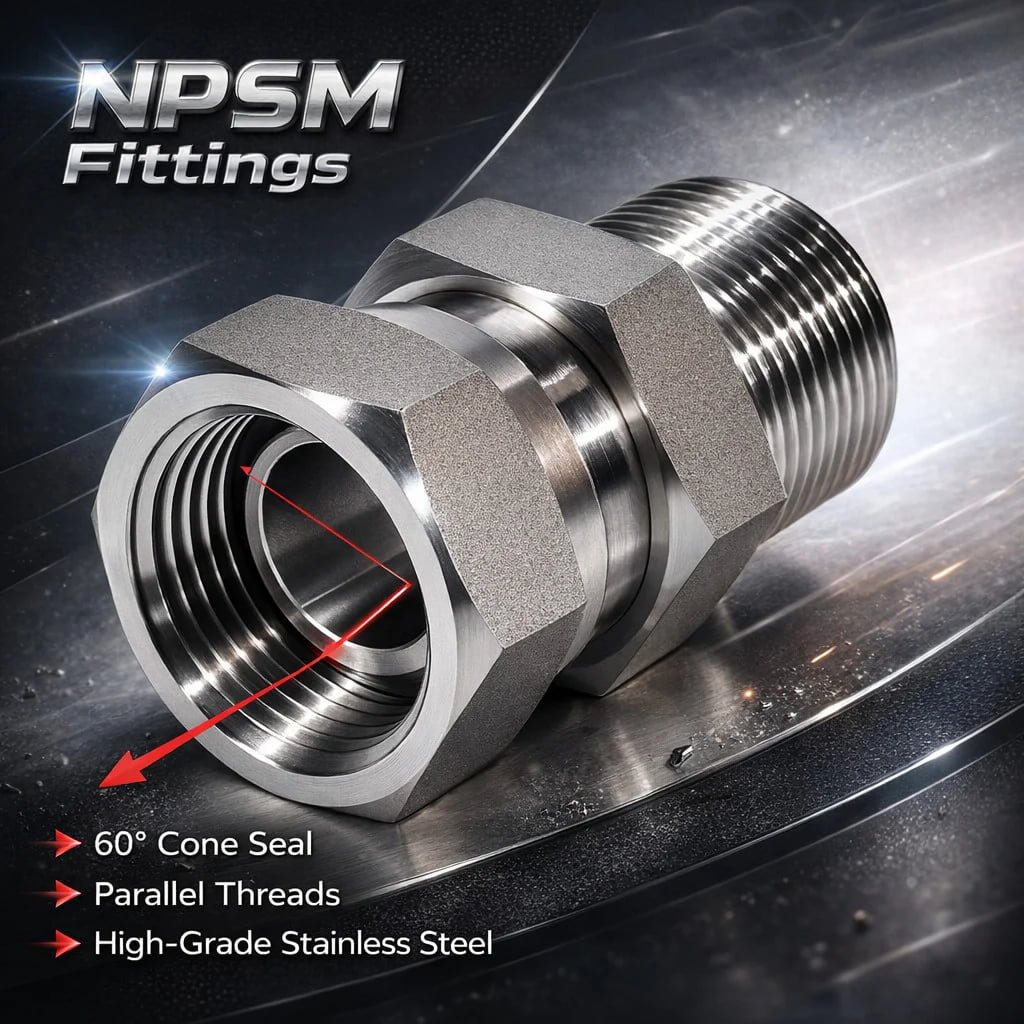
NPSM is a straight pipe thread that does not seal on the thread itself. It seals through a 60° cone seat, gasket, or O-ring at the mating surface.
Straight Thread Structure
NPSM threads:
- Have no taper
- Maintain constant diameter
- Follow Unified thread form
- Typically use Class 2A/2B tolerance
Because there is no taper, tightening does not create radial compression.
Thread engagement provides mechanical retention only.
How NPSM Achieves Sealing
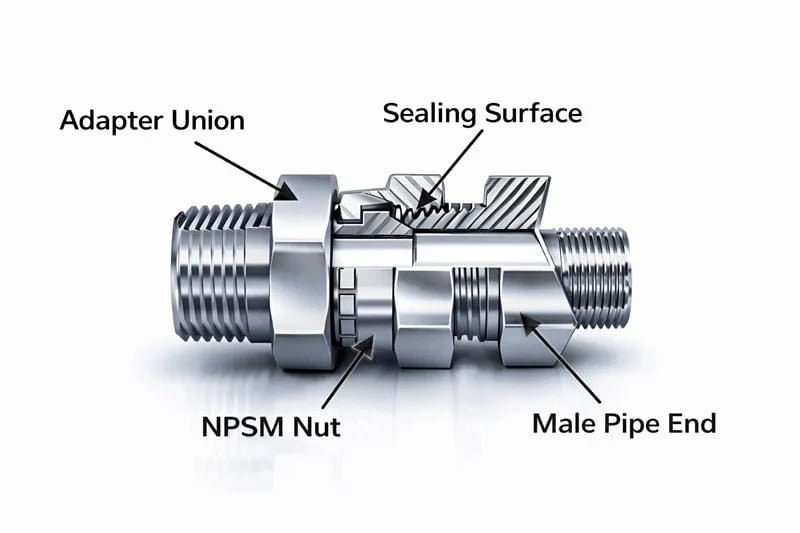
Sealing occurs at a secondary interface:
- 60° internal cone seat
- External gasket face
- O-ring compression surface
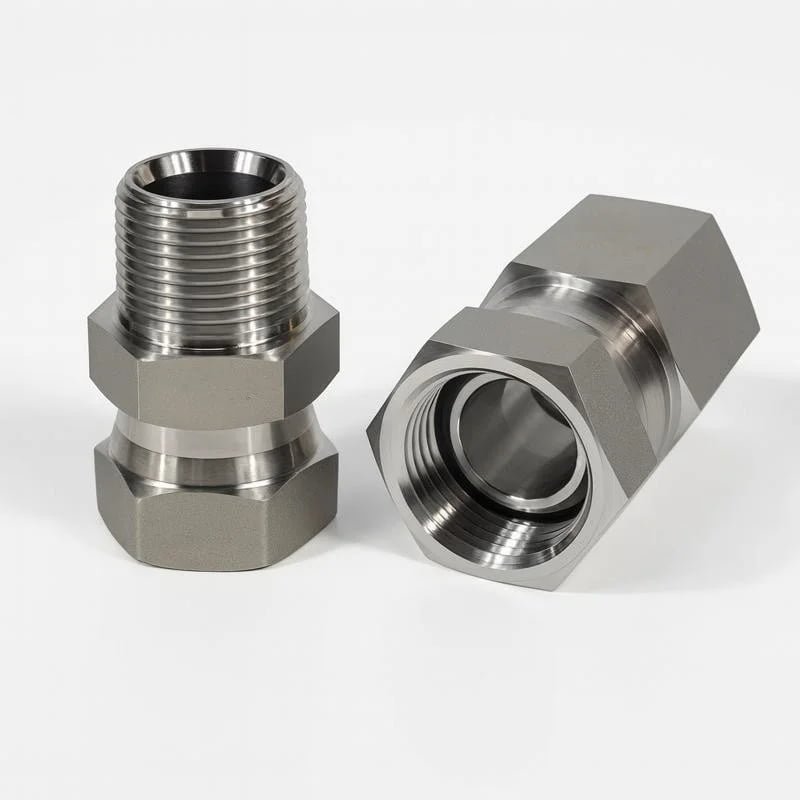
In many swivel hose fittings, the NPSM female contains a 60° cone. The male counterpart seals at that cone, not on the threads.
This is clearly shown in our swivel hose fitting series where NPSM connections rely on internal seat geometry rather than thread interference.
Thread torque simply pulls the sealing faces together.
Where NPSM Is Typically Used
I often see NPSM in:
- Swivel hose assemblies
- Low to medium pressure hydraulic return lines
- Instrumentation lines
- Service connections requiring reusability
Because threads are straight, repeated assembly causes less damage compared to NPT.
NPSM vs NPT: Technical Comparison Table
Engineers need data, not marketing words.
Here is the direct comparison:
| Feature | NPT | NPSM |
|---|---|---|
| Thread form | 60° tapered | 60° straight |
| Taper angle | 1° 47′ 24″ (1:16) | 0° |
| Sealing method | Thread flank interference | Cone seat / gasket / O-ring |
| Requires sealant? | Yes | No (for seat-sealed types) |
| Interchangeability | compatible with NPSM Female Swivel | Compatible with NPT Male with 60° Seat |
| Typical pressure range | Medium to high | Low to medium (seat-dependent) |
| Installation method | Torque to create wedge seal | Torque to compress sealing face |
Pressure capability depends on material and design. For reference, NPTF fittings in our hydraulic adapter catalog show rated pressures up to 34.5 MPa depending on size.
Can You Connect NPSM to NPT?
This is one of the most common buyer questions.
In most cases, NPSM and NPT should not be connected because their sealing mechanisms and geometry are different. However, when a NPT/NPTF male with 60° seat to connect with a NPSM Female swivel 60° seat, they can be sealed
Leakage Risk Analysis
Failure progression usually looks like this:
- Uneven thread flank engagement
- Stress concentration at first thread
- No uniform radial compression
- Spiral leak path remains
- Micro-leaks under pressure cycling
- Crack initiation in female port
Under vibration:
- Hydraulic pulses widen gaps
- Thermal expansion worsens mismatch
- Leak becomes visible after hours or days
Installation & Torque Best Practices
Most failures I see are installation errors.
Proper Sealant Use
For NPT:
- Apply PTFE tape 2–3 wraps
- Avoid covering first thread
- Do not over-apply liquid sealant
For NPSM seat-seal types:
- Do not use tape unless manufacturer specifies
- Ensure cone seat is clean
- Inspect O-ring if present
Torque Recommendations
Over-tightening is the biggest mistake with NPT.
Too little torque:
- Insufficient radial compression
- Leaks under pressure
Too much torque:
- Female port cracking
- Thread galling (especially stainless steel)
For stainless steel fittings, I always recommend anti-seize lubricant to prevent galling.
Avoiding Thread Damage
Common causes of damage:
- Cross-threading
- Mixing thread standards
- Dry assembly of stainless steel
- Using impact tools
In hydraulic hose assemblies, proper crimping and thread engagement both matter. Many leaks blamed on hoses are actually thread installation errors.
Common Mistakes Engineers Make
I see these mistakes repeatedly.
Over-tightening NPT
Many installers think “tighter is better.”
Excess torque:
- Expands female port
- Distorts sealing surface
- Reduces fatigue life
Assuming Threads Seal Themselves
NPT does not seal without sealant.
NPSM does not seal on threads at all.
Misunderstanding this difference leads to chronic leakage.
Ignoring Seat Seal on NPSM
If the 60° cone is scratched:
- Seal fails
- Threads still feel tight
- Leak appears immediately
Always inspect the sealing face, not just the threads.
How to Choose the Right Thread Type
Choosing correctly reduces field failure rates.
I use this decision framework:
1. Pressure Rating
- High pressure hydraulic → NPTF or O-ring face seal
- Medium pressure general → NPT acceptable
- Lower pressure with frequent disassembly → NPSM swivel
2. Vibration Exposure
- High vibration → Avoid pure tapered thread if possible
- Use O-ring or face seal design
3. Seal Requirements
- Zero leakage critical → Use O-ring-based systems
- General industrial → NPT acceptable
4. Maintenance Frequency
- Frequent removal → Straight thread with seat seal
- Permanent installation → Tapered thread acceptable
If your application requires repeated maintenance or clean reassembly, I usually recommend avoiding basic NPT.
FAQ Section
Does NPSM need PTFE tape?
No, if it seals on a 60° cone or gasket. The threads only provide mechanical retention.
Why does NPT leak?
NPT leaks due to insufficient torque, no sealant, over-tightening damage, or vibration loosening.
What standard defines NPSM?
NPSM is defined under ANSI/ASME B1.20.1 for straight mechanical pipe threads.
Is NPT stronger than NPSM?
Not inherently. Strength depends on material and engagement length. NPT provides radial interference, but both can handle significant pressure when correctly designed.
Conclusion
NPT seals by taper interference. NPSM seals by seat compression. Mixing them causes leaks, stress concentration, and failure. Choose based on pressure, vibration, and maintenance needs.
TITAN Fluid is a leading supplier of stainless steel NPT and NPSM Fittings for over 15 years. Contact us for more details.