Wrong fitting standards cause leaks, downtime, and costly rework. I see this every year with global buyers who mix JIS and JIC without knowing the risks.
JIS and JIC hydraulic fittings are not interchangeable because they use different thread systems and flare angles, even though they look similar. Choosing the wrong one leads to leaks, seal failure, and damaged ports.
Most sourcing problems I solve for buyers start with confusion around standards. So I want to break this down clearly, from basics to real-world decisions.
Why understanding hydraulic fitting standards matters?
Selecting the wrong fitting wastes time, money, and trust. I have seen full containers rejected because of one wrong assumption.
Understanding fitting standards prevents leaks, avoids port damage, and ensures safe pressure performance across global equipment platforms.
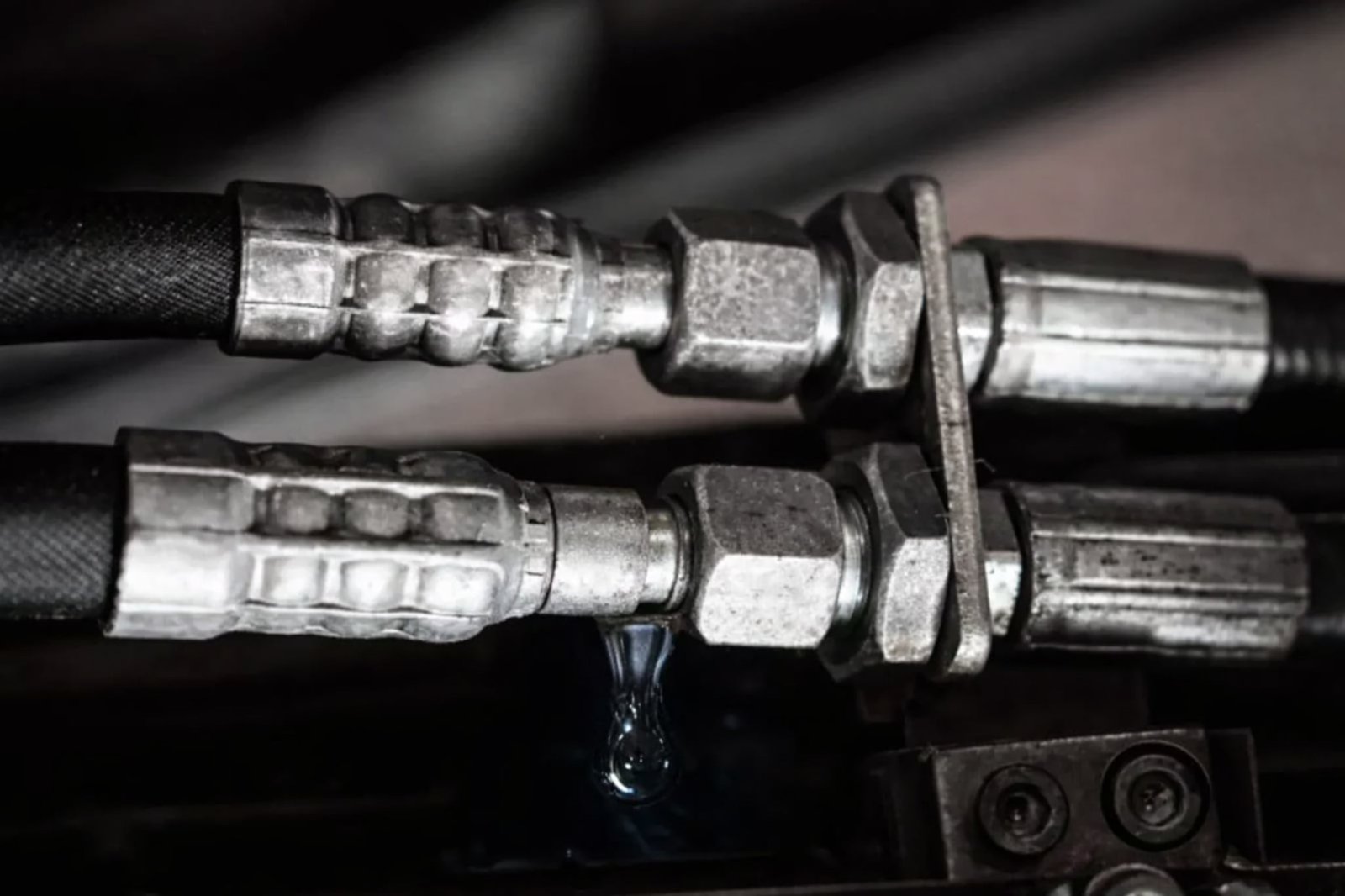
Mis-selection causes hidden failures
Many buyers assume “close enough” works in hydraulics. That mindset creates micro leaks that only appear under pressure. These leaks grow over time.
Certification does not fix wrong standards
Even if materials are SS316L and certificates are real, a wrong standard still fails. Quality materials cannot compensate for geometry mismatch.
Rebranding risk for global buyers
If you rebrand products for US or EU markets, your customers expect correct standards. One complaint damages long-term relationships.
What Are Hydraulic Flare Fittings?
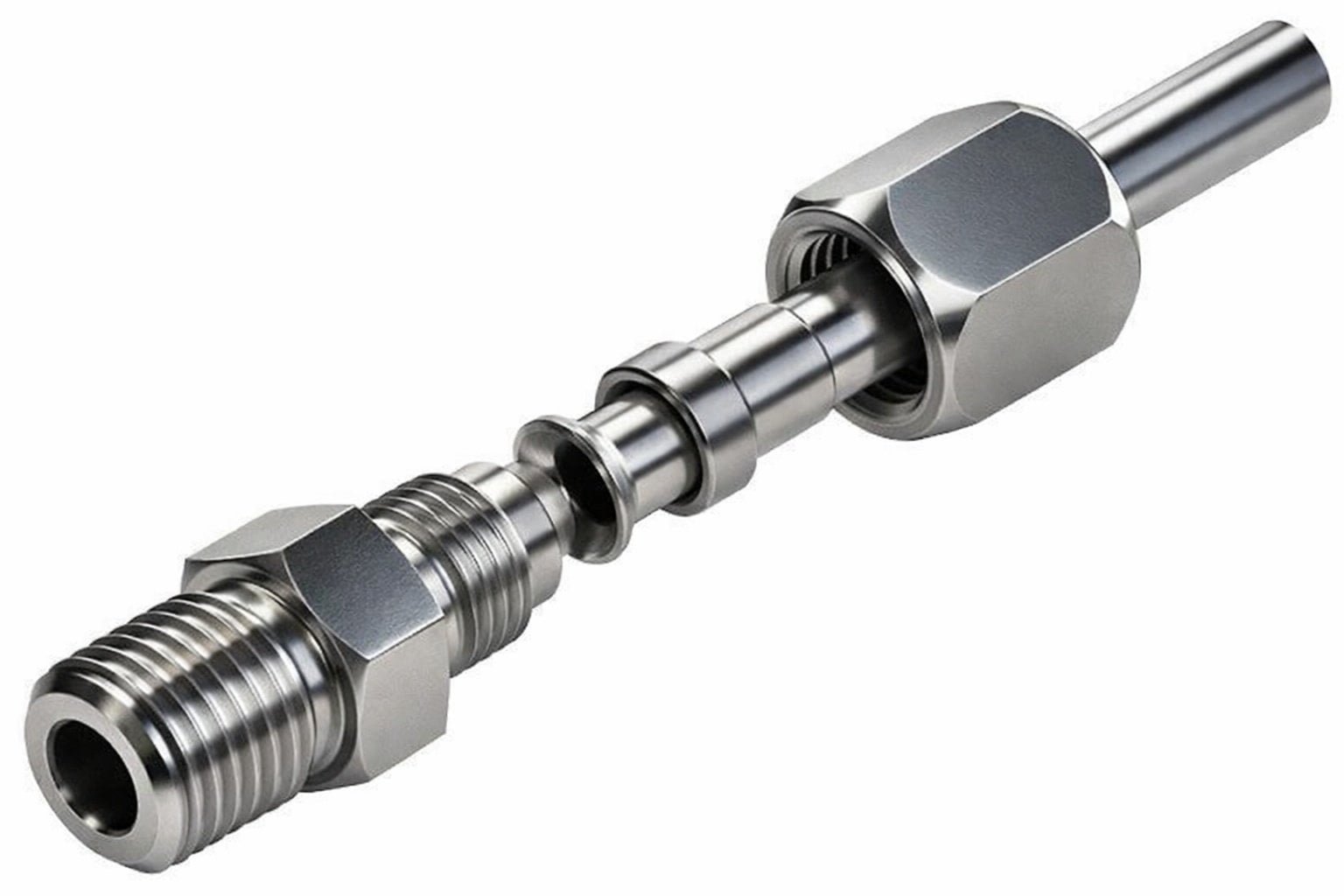
Flare fittings seal using metal-to-metal contact, not thread deformation. The seal happens at the cone, not the thread.
Hydraulic flare fittings seal by compressing a flared tube end against a matching cone angle to create a high-pressure metal seal.
Why flare angle matters
The sealing cone angle must match exactly. Even a small difference reduces contact area and causes leaks.
Role of standards
Standards define flare angle, thread form, pitch, and tolerances. This ensures compatibility across manufacturers.
Pressure performance
Correct flare fittings handle vibration and high pressure better than pipe threads because the seal does not rely on thread friction.
What’s JIS Standard Fitting?
JIS stands for Japanese Industrial Standards. These are widely used across Asian OEM platforms.
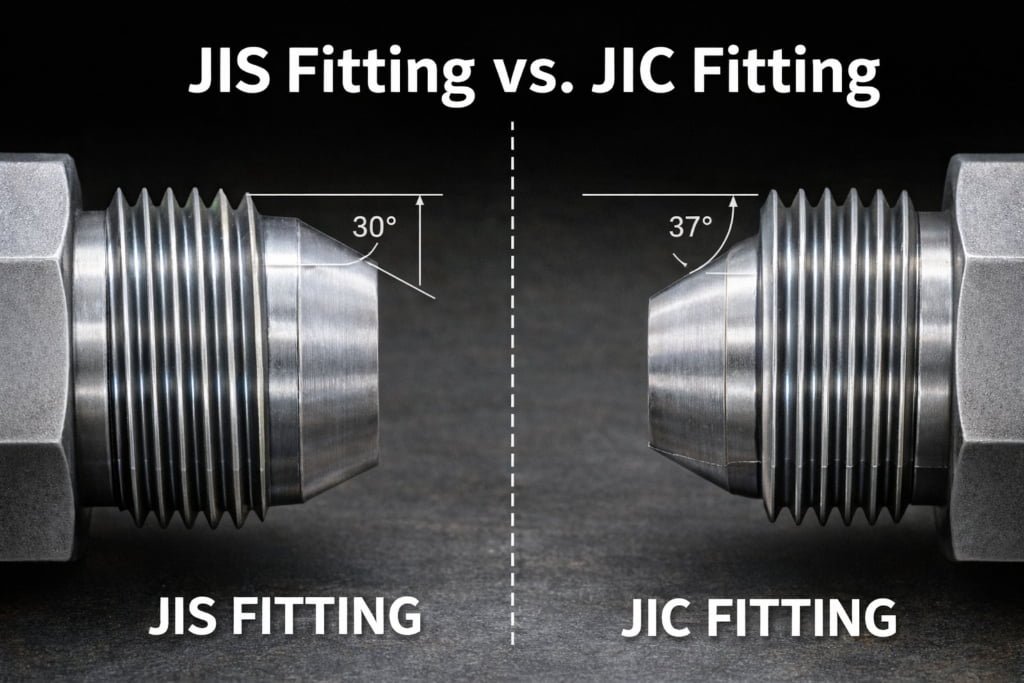
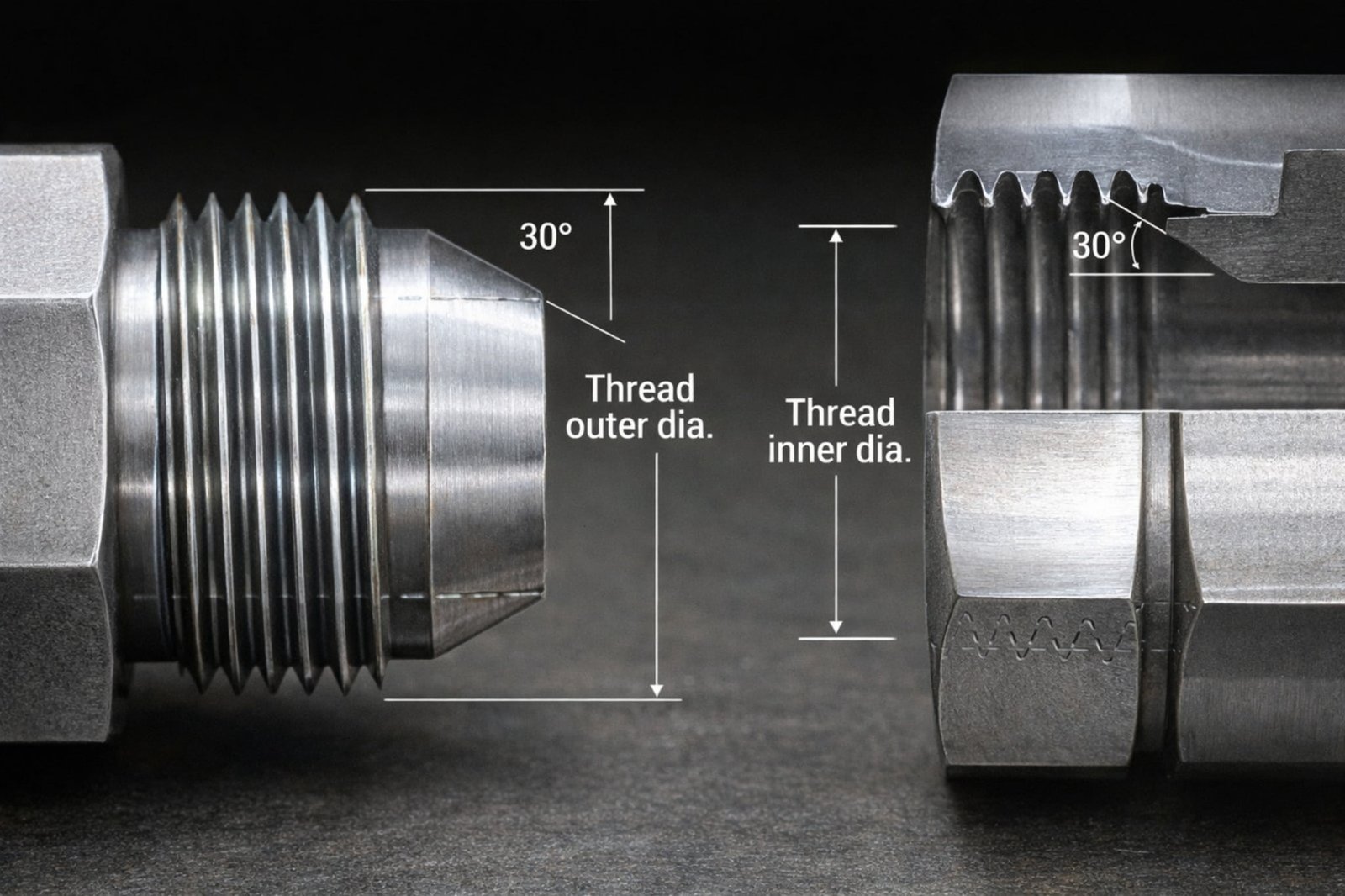
JIS hydraulic fittings follow Japanese Industrial Standards and typically use metric threads with a 30° flare sealing system.
Key specifications
Common references include JIS B8363. These standards define thread size, pitch, and flare geometry.
JIS Thread Size and flare design
Most JIS flare fittings use metric threads with a 30° seat. Some variants also use BSP threads with 30° flare.
| Inch size | Dash size | Thread Size | Male Thread O.D. (in) | Female thread O.D (in) |
|---|---|---|---|---|
| 1/8 | -2 | 1/8 – 28 | 3/8 | 11/32 |
| 1/4 | -4 | 1/4 – 19 | 33/64 | 15/32 |
| 3/8 | -6 | 3/8 – 19 | 21/32 | 19/32 |
| 1/2 | -8 | 1/2 – 14 | 13/16 | 3/4 |
| 5/8 | -10 | 5/8 – 14 | 7/8 | 13/16 |
| 3/4 | -12 | 3/4 – 14 | 1 1/32 | 31/32 |
| 1 | -16 | 1 – 11 | 1 5/16 | 1 7/32 |
| 1 1/4 | -20 | 1 1/4 – 11 | 1 21/32 | 1 9/16 |
| 1 1/2 | -24 | 1 1/2 – 11 | 1 7/8 | 1 25/32 |
| 2 | -32 | 2 – 11 | 2 11/32 | 2 1/4 |
Typical materials
Carbon steel and stainless steel are common. In corrosive or marine environments, SS316L dominates.
Where JIS is used
You see JIS fittings on Japanese and Korean equipment. Excavators, injection machines, forklifts, and factory automation rely heavily on JIS.
What’s JIC Standard Fitting?
JIC stands for Joint Industry Council and is deeply rooted in North American hydraulic systems.
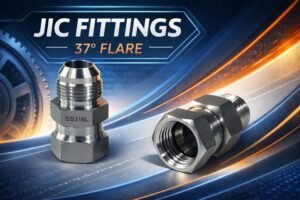
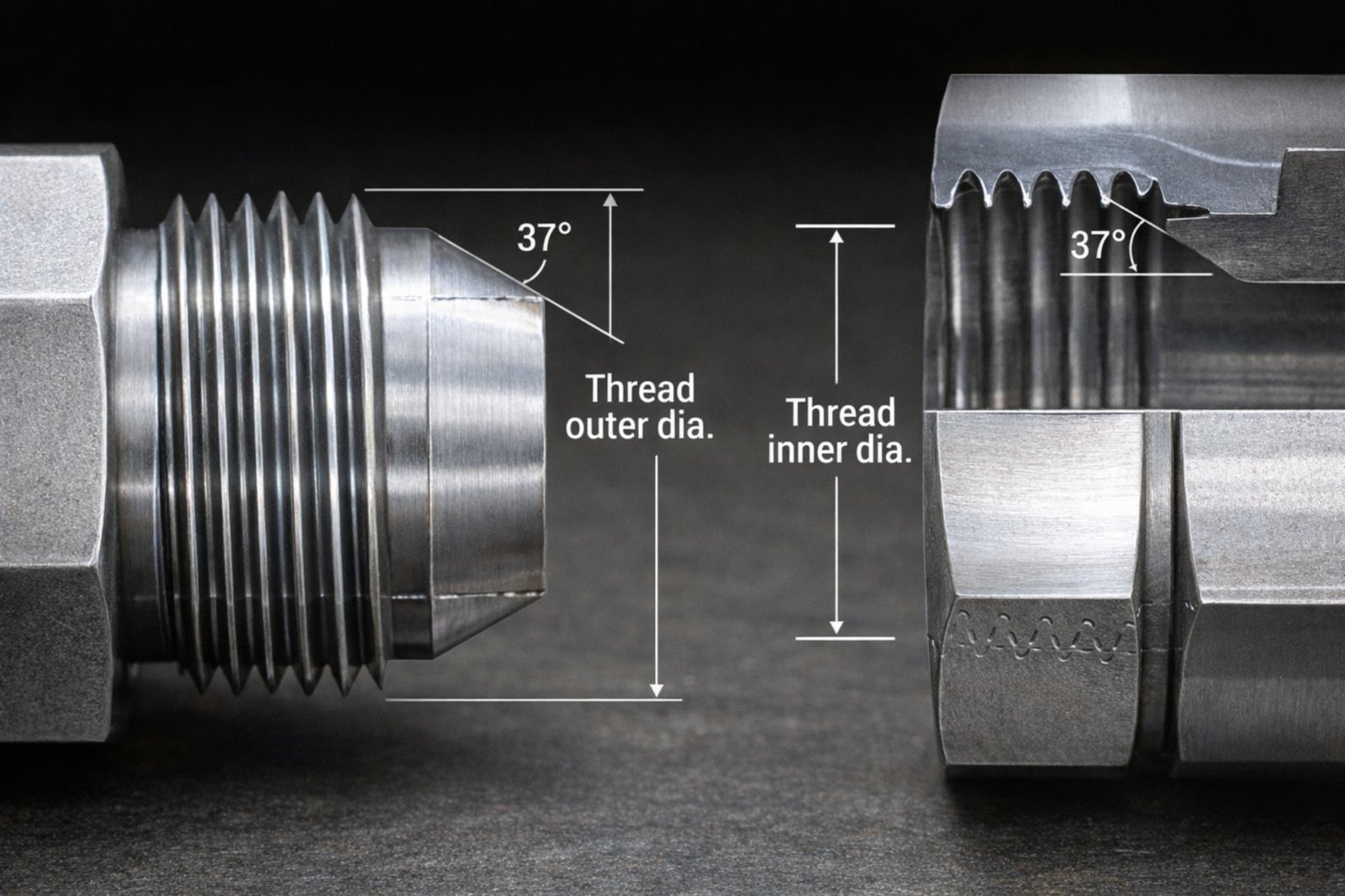
JIC hydraulic fittings use UNF threads and a 37° flare, standardized under SAE specifications for high-pressure systems.
Governing standards
SAE J514 and MIL-DTL-18866 define geometry and performance for JIC fittings.
JIC Thread Size
JIC uses Unified National Fine threads. These threads are common in US-made equipment and hoses.
| Inch size | Dash size | Thread Size | Male Thread O.D. (in) | Female thread O.D (in) |
|---|---|---|---|---|
| 1/8 | -2 | 5/16 – 24 | 5/16 | 9/32 |
| 3/16 | -3 | 3/8 – 24 | 3/8 | 11/32 |
| 1/4 | -4 | 7/16 – 20 | 7/16 | 13/32 |
| 5/16 | -5 | 1/2 – 20 | 1/2 | 15/32 |
| 3/8 | -6 | 9/16 – 18 | 9/16 | 17/32 |
| 1/2 | -8 | 3/4 – 16 | 3/4 | 11/16 |
| 5/8 | -10 | 7/8 – 14 | 7/8 | 13/16 |
| 3/4 | -12 | 1 1/16 – 12 | 1 1/16 | 1 |
| 7/8 | -14 | 1 3/16 – 12 | 1 3/16 | 1 1/8 |
| 1 | -16 | 1 5/16 – 12 | 1 5/16 | 1 1/4 |
| 1 1/4 | -20 | 1 5/8 – 12 | 1 5/8 | 1 9/16 |
| 1 1/2 | -24 | 1 7/8 – 12 | 1 7/8 | 1 13/16 |
| 2 | -32 | 2 1/2 – 12 | 2 1/2 | 2 7/16 |
Sealing method
The 37° flare provides a strong metal-to-metal seal that performs well under vibration and pressure cycling.
Global adoption
Although American in origin, JIC is now used worldwide, especially in oil and gas, hydraulics, and industrial equipment.
Side-by-Side Technical Comparison?
Engineers need clear differences, not marketing words.
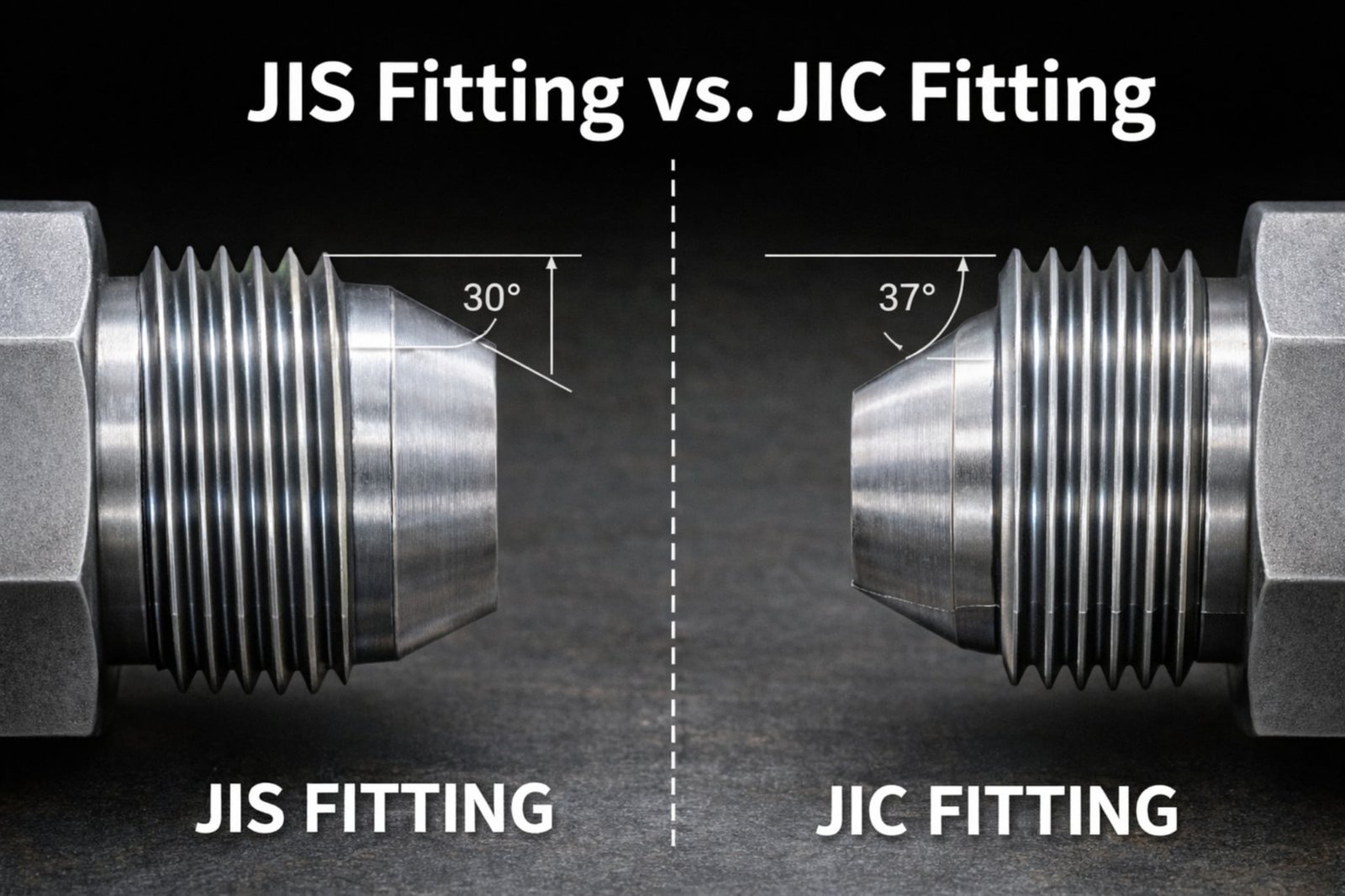
JIS and JIC differ in flare angle, thread type, and regional standards, making them mechanically incompatible.
| Feature | JIS | JIC |
|---|---|---|
| Standard / Origin | Japanese Industrial Standard | SAE / Joint Industry Council |
| Thread Type | Metric or BSP | UNF |
| Flare Angle | 30° | 37° |
| Typical Pressure | Medium to high | High, up to ~10,000 psi |
| Common Regions | Asia | North America, Global |
| Interchangeable | No | No |
Visual similarity trap
At a glance, JIS and JIC look almost identical. This causes frequent mistakes in warehouses and workshops.
Pressure expectations
JIC systems are often designed for higher pressure margins compared to JIS.
Why They Can’t Be Interchanged?
This is the most costly misunderstanding I see.
JIS and JIC fittings cannot be interchanged because mismatched threads and flare angles prevent proper sealing.
Thread mismatch
Metric threads and UNF threads may start threading but will bind or strip under torque.
Flare angle mismatch
A 30° flare will only contact a 37° cone at a narrow ring. This causes point loading and leaks.
Real risks
Leaks contaminate systems. Over-tightening cracks ports. Repairs cost far more than correct sourcing.
How to Identify Fittings in the Field?
Identification saves hours of rework.
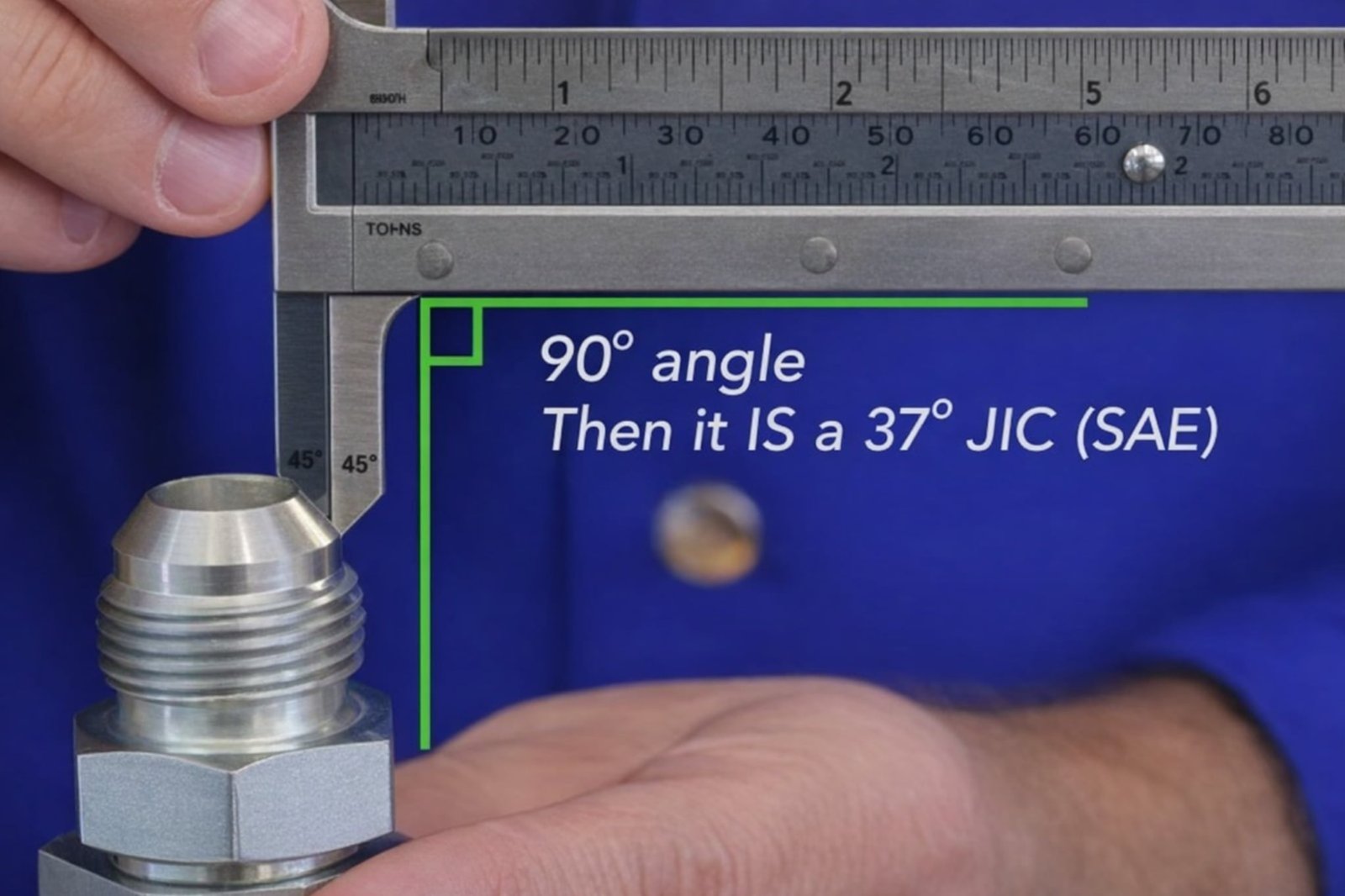
You can identify JIS and JIC fittings by measuring flare angle, checking thread pitch, and inspecting markings.
Measure the flare
Use a flare gauge or optical comparator. Never guess by eye.
Check thread pitch
Thread gauges quickly reveal metric versus UNF threads.
Look for markings
Some manufacturers stamp JIS or JIC codes, but never rely on markings alone.
Choosing the Right Fitting for Your Application?
Correct selection starts with system context.
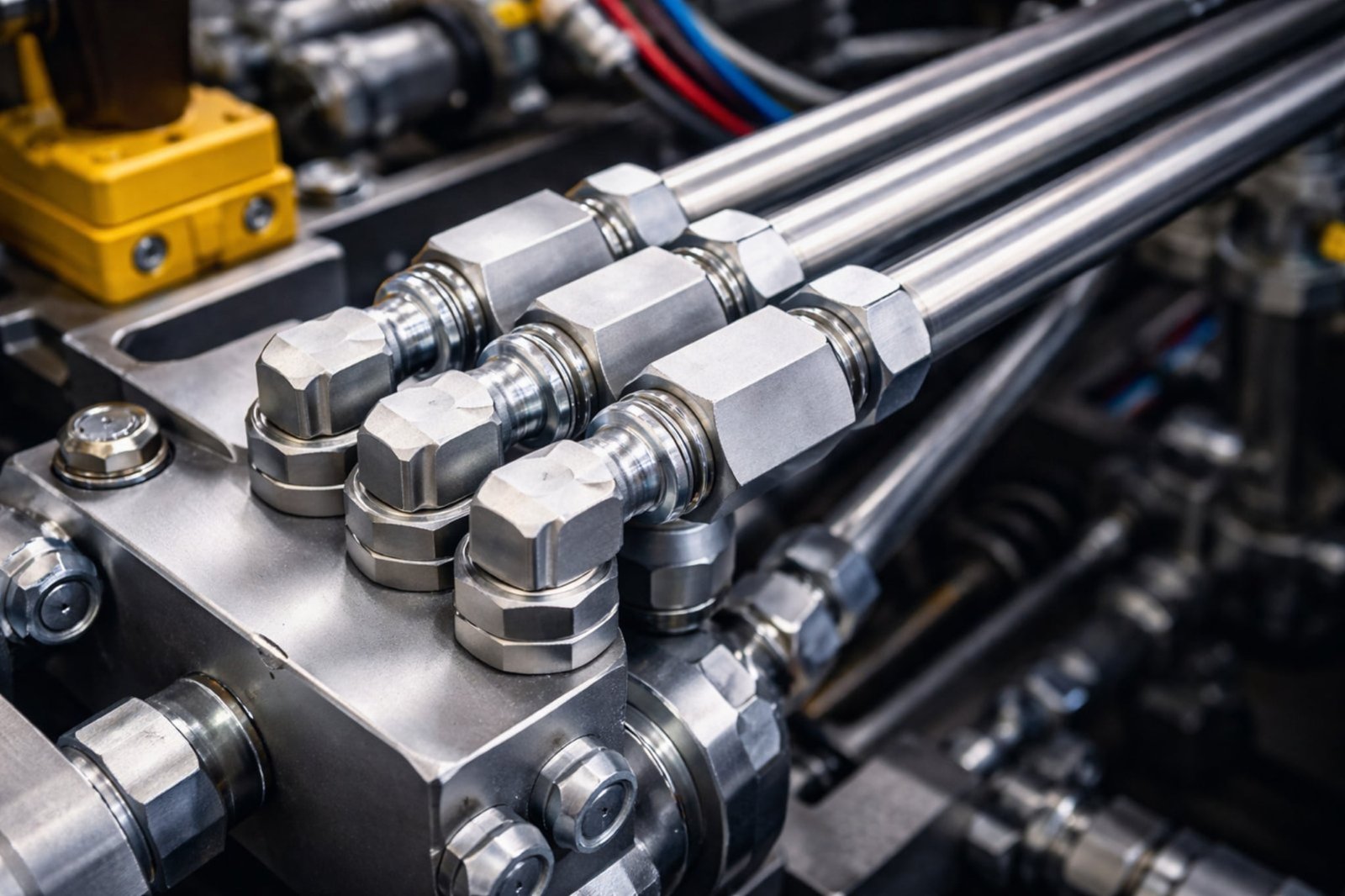
The right fitting depends on equipment standard, operating pressure, and regional supply compatibility.
Equipment standard first
Always match the OEM standard. Adapters should be a last option, not default.
Pressure and vibration
High-pressure or mobile equipment favors JIC designs due to their robustness.
Supplier capability
Your supplier must understand standards, not just sell parts. Communication quality matters.
Adapters & Conversion Solutions?
Adapters solve problems but add risk.
Adapters allow JIS-to-JIC connections but introduce extra leak points and should be used only when necessary.
When adapters make sense
Retrofit projects and mixed fleets often require adapters.
Adapter types
Common options include JIS-to-JIC male-female adapters and thread converters.
Risks to manage
Each adapter adds length, weight, and a new sealing surface.
FAQs?
Buyers ask these questions repeatedly.
JIS and JIC serve different systems, and neither is universally better without context.
Can JIS and JIC be used together?
Only with proper adapters. Direct connection is unsafe.
Which is better for high pressure?
JIC typically handles higher pressures more reliably.
Material recommendations
For corrosive environments, I always recommend SS316L with verified material certificates.
Conclusion
JIS and JIC look similar but differ in threads, flare angles, and standards. Match the fitting to the system, verify before ordering, and never assume interchangeability.
TITAN Fluid is a leading supplier of stainless steel hydraulic tube fittings, download the catalog at www.titanfluid.com