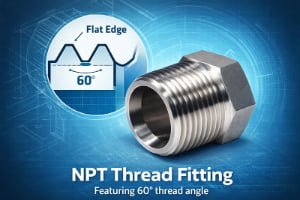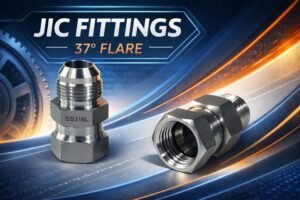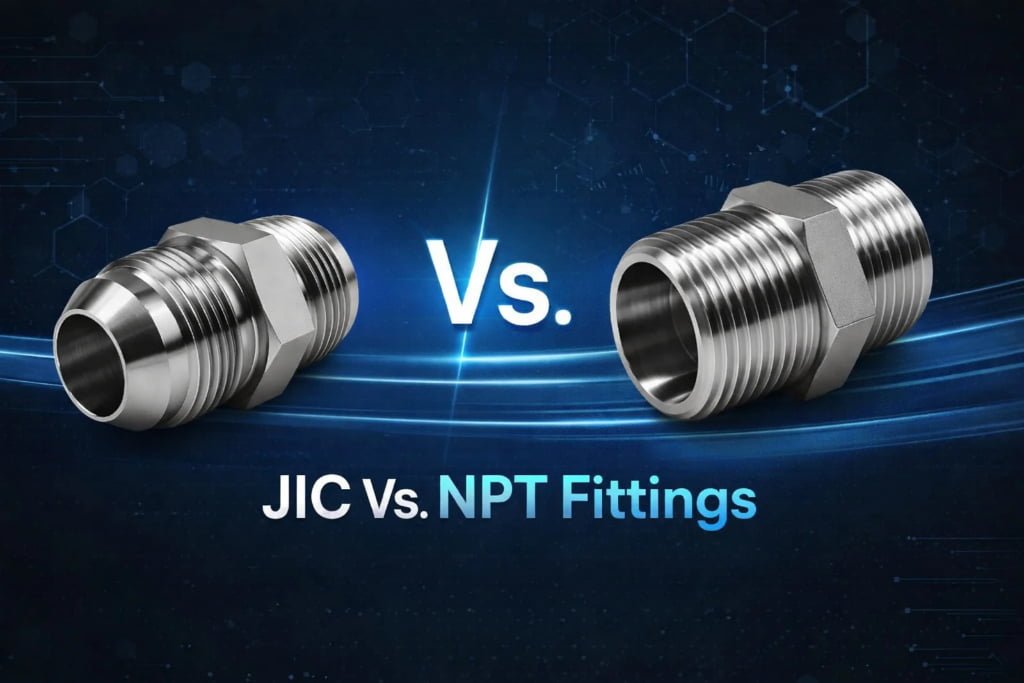
Wrong thread choice causes leaks, downtime, and rework. Many buyers mix hydraulic and pipe threads by mistake. I see this problem every month with new customers.
JIC and NPT fittings are not the same. JIC uses a 37° metal-to-metal flare seal, while NPT relies on tapered threads and sealant. They serve different pressure levels and should not be mixed directly.
I have worked with both thread systems for over 15 years. In this guide, I will explain the real differences so you can choose correctly and avoid costly failures.
Why Does Understanding Thread Types Matter?
Poor thread knowledge leads to leaks, cracked ports, and rejected shipments. Many buyers focus on size only and ignore sealing design.
The problem is simple. Hydraulic threads and pipe threads seal in completely different ways. When they are mixed, the connection may feel tight but will fail under pressure.
Understanding thread types matters because sealing method, pressure rating, and safety all depend on correct thread selection.
What Are JIC Fittings?
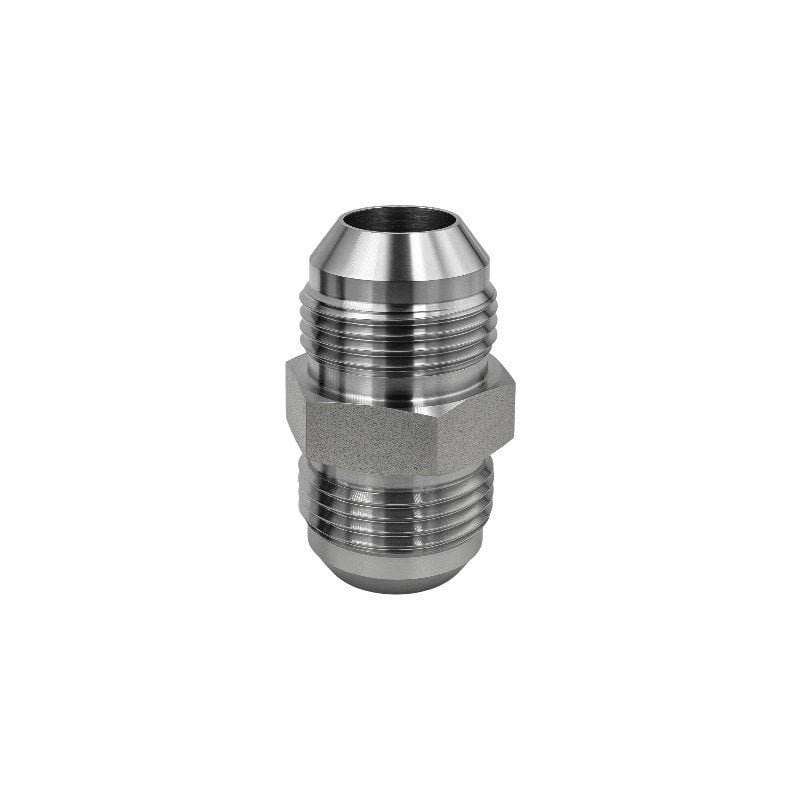
Many buyers hear “JIC” but do not understand how it actually seals. This leads to misuse.
JIC fittings are hydraulic fittings defined by SAE standards. They seal using a precision-machined flare, not the threads.
JIC fittings use a 37° flare metal-to-metal seal defined by SAE J514 and MIL-DTL-18866, designed for high-pressure hydraulic systems.
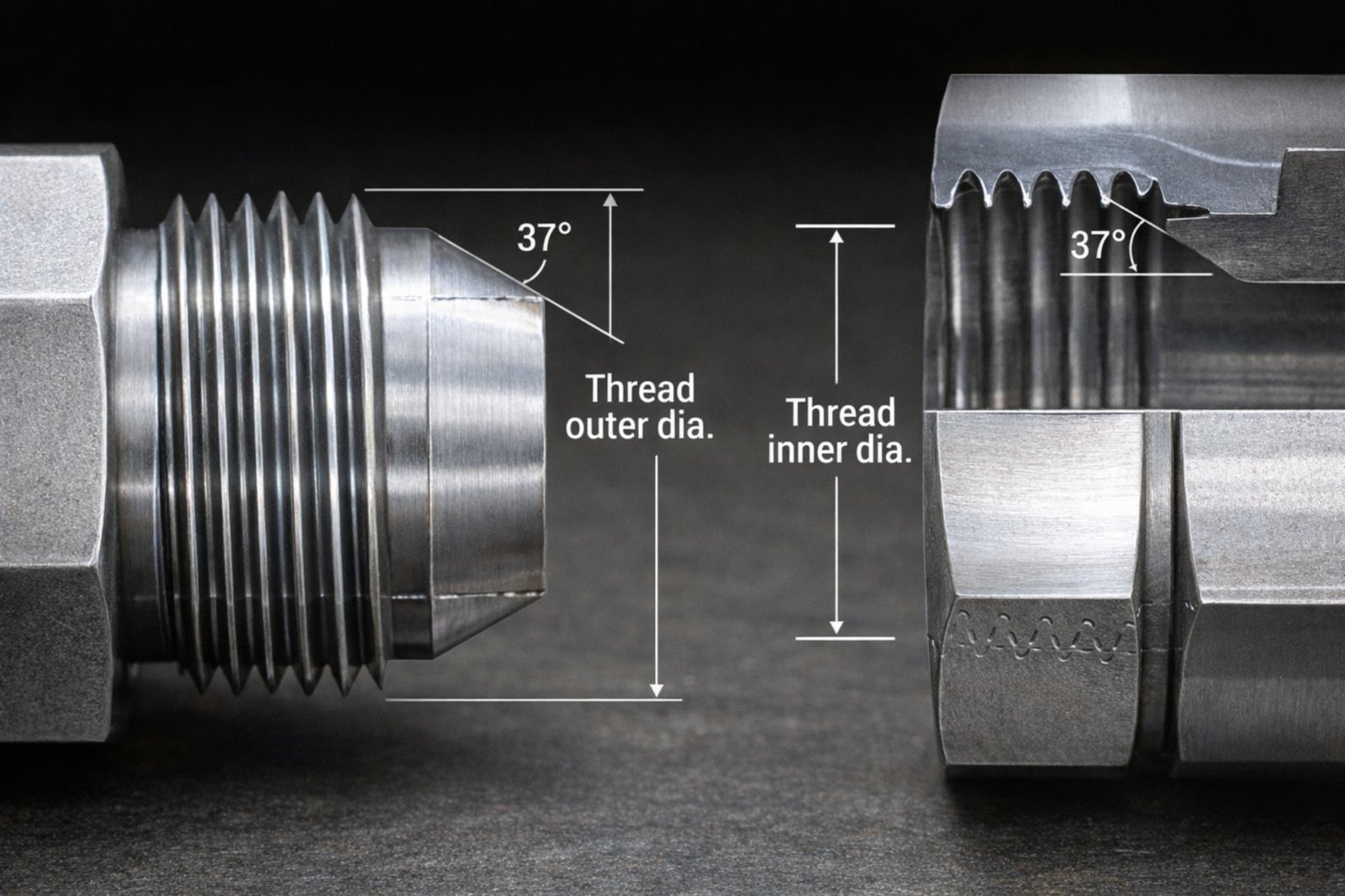
JIC Thread Size
JIC (Joint Industry Council) thread sizes are based on the outside diameter (OD) of the tube, not the thread itself. The sizes are often referred to by a dash number (e.g., -04, -06), which corresponds to the tube OD in sixteenths of an inch.
Below is a standard JIC thread size chart:
| Dash Size | Tube OD (in) | Thread Size (UNF) | Thread OD (in) |
|---|---|---|---|
| -02 | 1/8" | 5/16-24 | 0.3125" |
| -03 | 3/16" | 3/8-24 | 0.3750" |
| -04 | 1/4" | 7/16-20 | 0.4375" |
| -05 | 5/16" | 1/2-20 | 0.5000" |
| -06 | 3/8" | 9/16-18 | 0.5625" |
| -08 | 1/2" | 3/4-16 | 0.7500" |
| -10 | 5/8" | 7/8-14 | 0.8750" |
| -12 | 3/4" | 1 1/16-12 | 1.0625" |
| -16 | 1" | 1 5/16-12 | 1.3125" |
| -20 | 1-1/4" | 1 5/8-12 | 1.6250" |
Notes:
- Always measure the outer diameter of the tube, not the fitting thread, to determine the correct JIC size.
- Use a caliper or thread gauge for accurate identification.
- JIC fittings use a 37° flare for sealing, which makes them suitable for high-pressure hydraulic systems.
JIC standards and control
JIC fittings follow SAE J514. Thread form, flare angle, and tolerances are controlled tightly. This makes them repeatable across suppliers.
How the 37° flare seals
The male flare contacts the female cone. When tightened, pressure increases at the flare surface. Threads only provide holding force.
Pressure capability
Because sealing happens at the flare, JIC handles high pressure very well. Stainless steel JIC fittings commonly work above 3,000 PSI when designed correctly.
Common applications
I see JIC used in hydraulic power units, mobile equipment, fuel systems, and test rigs. OEMs prefer JIC because it is reliable and easy to inspect.
Why OEMs trust JIC
No sealant is required. No curing time exists. Assembly quality can be visually confirmed. These factors reduce warranty risk.
What Are NPT Fittings?
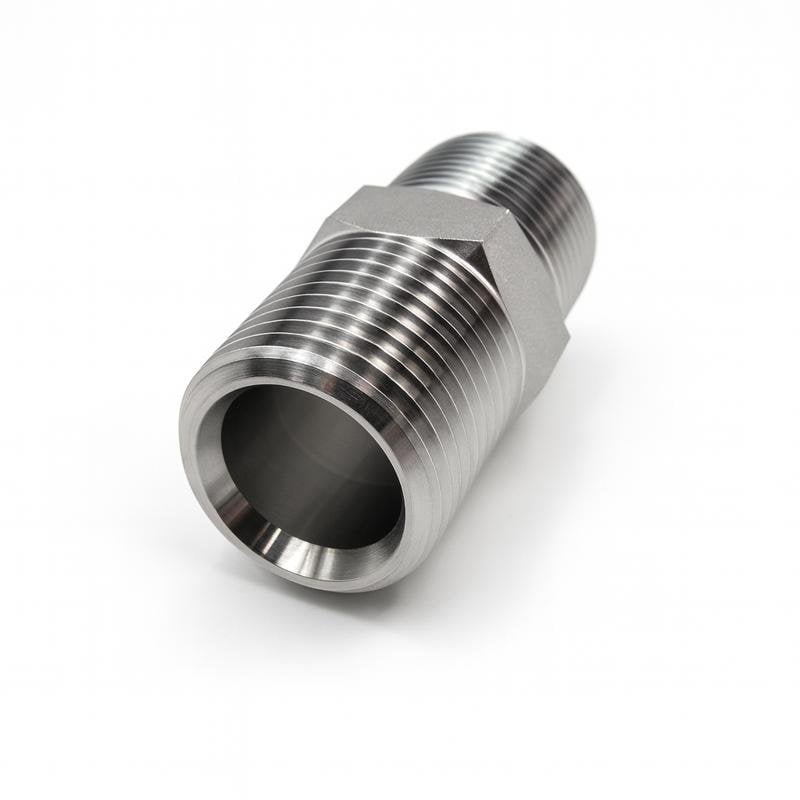
NPT fittings look simple, but many problems come from misunderstanding their limits.
NPT is a pipe thread standard mainly for general piping. It seals through thread interference, not precision surfaces.
NPT fittings use tapered threads defined by ANSI/ASME B1.20.1 and usually require sealant to prevent leakage.
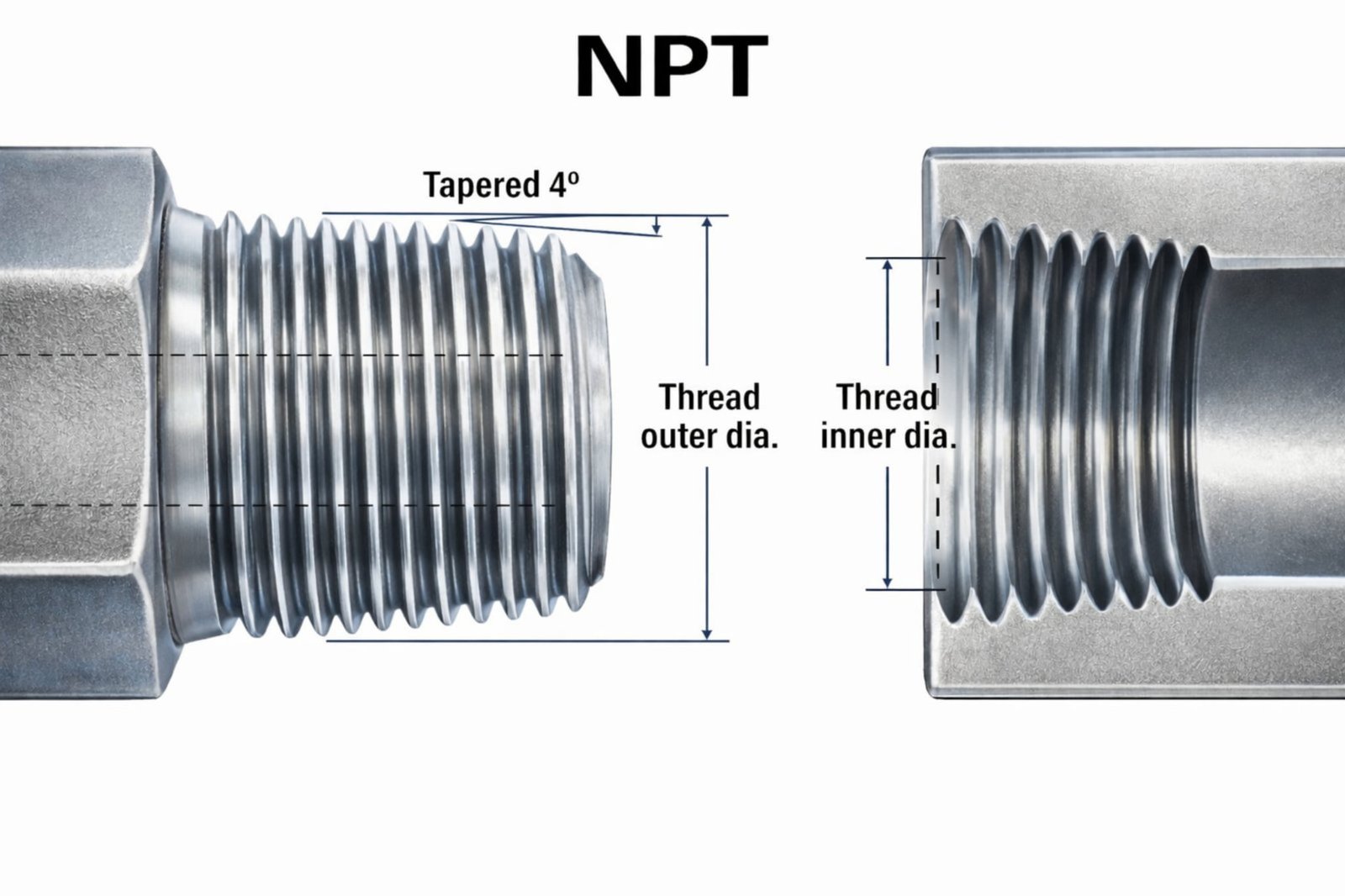
NPT Thread Size
NPT (National Pipe Tapered) threads are measured differently from JIC. NPT sizes are based on the nominal pipe size (NPS), which does not correspond directly to either the thread OD or the inner diameter (ID) of the pipe. NPT threads are tapered, which means the diameter decreases along the length of the thread to form a seal when tightened.
Below is a standard NPT thread size chart:
| Nominal Size | Threads per Inch (TPI) | Thread OD (in) | Thread Type |
|---|---|---|---|
| 1/16" | 27 | 0.3125" | NPT |
| 1/8" | 27 | 0.4050" | NPT |
| 1/4" | 18 | 0.5400" | NPT |
| 3/8" | 18 | 0.6750" | NPT |
| 1/2" | 14 | 0.8400" | NPT |
| 3/4" | 14 | 1.0500" | NPT |
| 1" | 11.5 | 1.3150" | NPT |
| 1-1/4" | 11.5 | 1.6600" | NPT |
| 1-1/2" | 11.5 | 1.9000" | NPT |
| 2" | 11.5 | 2.3750" | NPT |
Notes:
- NPT threads require thread sealant (like PTFE tape) to ensure a leak-proof connection.
- The tapered design forms a seal by wedging the male and female threads together.
- Measuring NPT threads requires understanding of both thread OD and TPI, not just tube or pipe OD.
Tapered thread design
NPT threads taper at 1 in 16. As the fitting tightens, threads wedge together and deform slightly.
Role of sealants
Thread tape or liquid sealant fills micro-gaps. Without sealant, most NPT joints will leak under pressure.
Pressure limitations
NPT works well at low to medium pressure. At higher pressure, vibration and thermal cycling loosen the joint.
Typical applications
I mostly see NPT in air systems, cooling lines, oil return lines, and utility piping.
Stainless steel challenges
Stainless NPT fittings gall easily. Over-tightening is common and often cracks female ports.
NPT vs. NPTF
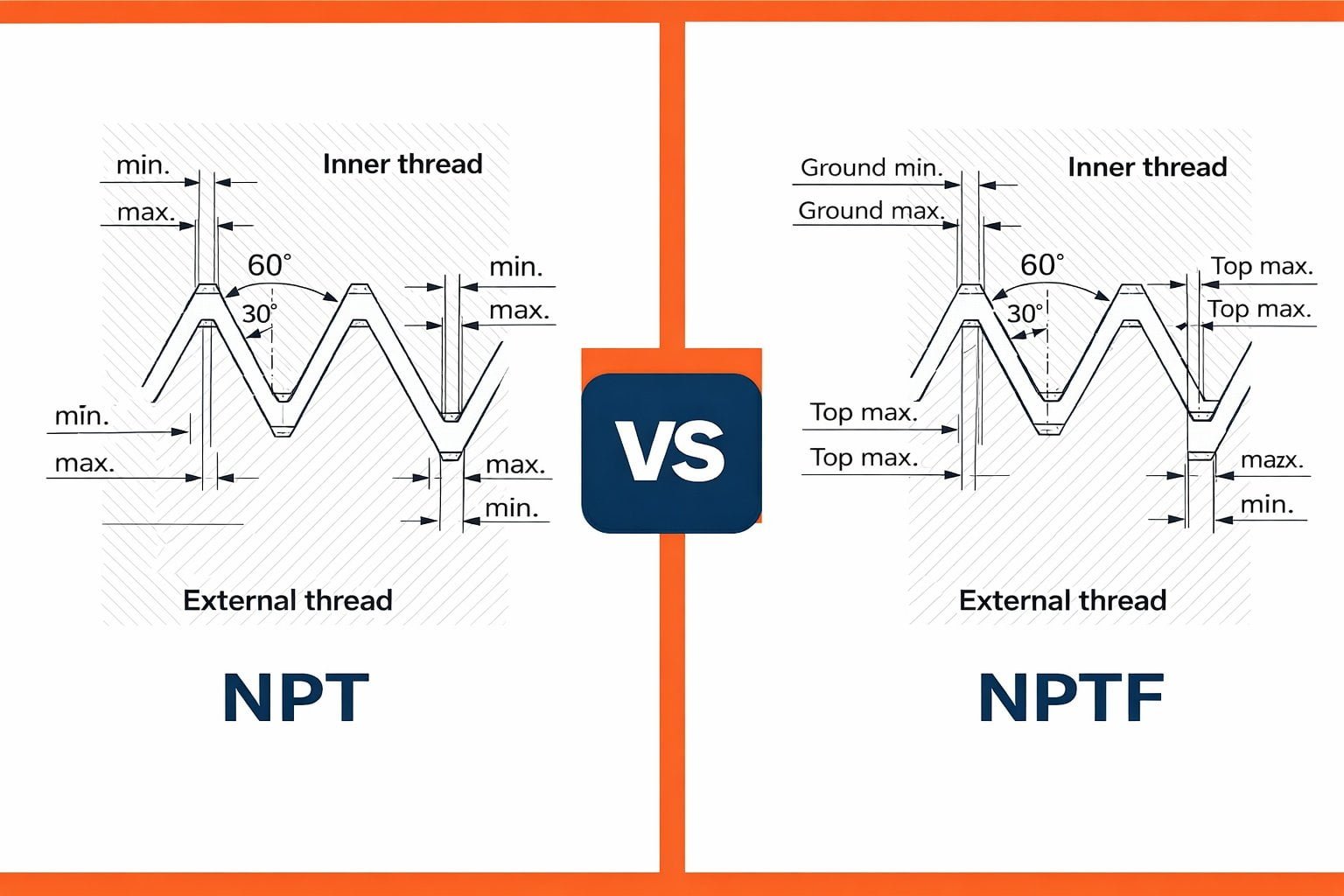
Although NPT and NPTF threads share the same taper angle and thread pitch, they differ in sealing method and intended use.
| Feature | NPT | NPTF |
|---|---|---|
| Full Name | National Pipe Taper | National Pipe Taper Fuel (Dryseal) |
| Standard | ANSI/ASME B1.20.1 | ANSI/ASME B1.20.3 |
| Thread Type | Tapered | Tapered (with tighter tolerances) |
| Sealing Method | Requires sealant (e.g., PTFE) | Dryseal – no sealant required |
| Seal Type | Thread deformation with sealant | Metal-to-metal interference fit |
| Common Use Cases | Water, gas, air systems | Fuel, hydraulic, high-pressure systems |
Summary:
- NPT relies on thread sealant to prevent leaks.
- NPTF achieves a seal through precise thread engagement and does not require sealant.
- Despite having the same thread profile, they are not interchangeable in critical sealing applications.
✅ Always check the application requirements before choosing between NPT and NPTF, especially in systems where leaks are unacceptable.
What Are the Key Technical Differences Between JIC and NPT?
Many buyers ask for a simple comparison. The differences are mechanical, not cosmetic.
JIC and NPT differ in thread shape, sealing method, pressure rating, and installation approach.
JIC uses parallel threads with a 37° flare seal, while NPT uses tapered threads that seal by deformation and sealant.
| Feature | JIC | NPT |
|---|---|---|
| Thread type | Parallel UNF | Tapered |
| Sealing method | 37° metal-to-metal | Thread deformation |
| Sealant needed | No | Usually yes |
| Pressure range | High | Low to medium |
| Reusability | Excellent | Limited |
Are JIC and NPT Fittings Interchangeable?
This is one of the most dangerous assumptions in fluid systems.
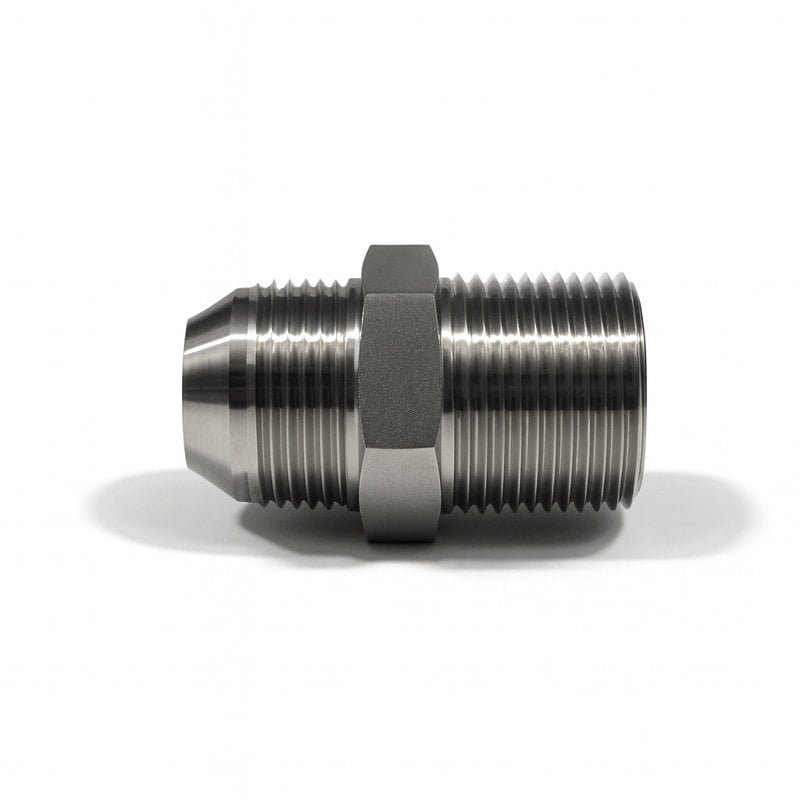
JIC and NPT may thread together partially, but they do not seal correctly.
JIC and NPT fittings are not interchangeable and should never be connected directly without a proper adapter.
Why they seem to fit
Thread diameters are similar for some sizes. This creates a false sense of compatibility.
Real failure modes
I have seen cracked ports, stripped threads, and sudden blowouts caused by direct mixing.
When adapters are acceptable
Adapters designed with JIC on one side and NPT on the other are safe. Each side seals as intended.
When adapters are not enough
In high-cycle or safety-critical systems, I recommend avoiding NPT completely.
How Do I Choose the Right Fitting for My System?
Choosing fittings should be a technical decision, not a habit.
The correct fitting depends on pressure, fluid type, environment, and maintenance needs.
Choose JIC for high-pressure hydraulic systems and NPT for low-pressure general piping where sealants are acceptable.
Pressure first
Always start with maximum working pressure and safety factor.
Fluid compatibility
Aggressive fluids attack sealants. JIC avoids this issue completely.
Environment and vibration
Mobile equipment favors JIC. Static piping tolerates NPT.
Global serviceability
JIC is globally standardized. This matters for OEM export markets.
My rule of thumb
If pressure matters, I choose JIC. If cost matters and pressure is low, NPT is acceptable.
What Are the Best Installation Practices?
Even the best fitting fails if installed incorrectly.
Proper torque, cleanliness, and inspection determine long-term performance.
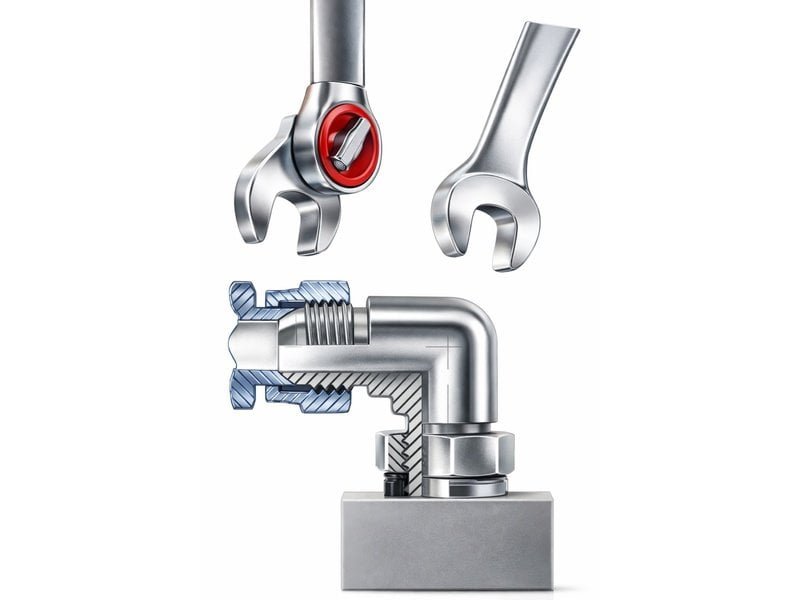
Correct installation practices prevent leaks, galling, and premature failure for both JIC and NPT fittings.
JIC installation basics
Clean flare surfaces. Align before tightening. Torque to specification. Do not use sealant.
NPT installation basics
Apply sealant evenly. Do not overtighten. Leave one to two threads visible.
Stainless steel precautions
Always lubricate threads lightly. This reduces galling risk.
Final inspection
Pressure test every assembly. Visual checks are not enough.
What Are the Most Common Mistakes and How Can I Avoid Them?
Most fitting failures come from human error, not product defects.
Mistakes repeat because teams rely on habit instead of standards.
The most common mistakes are thread misidentification and mixing standards without proper adapters.
Misreading drawings
Always confirm thread callouts. Never assume based on size alone.
Mixing standards
JIC, NPT, BSPP, and metric threads all look similar at first glance.
Over-tightening
More torque does not mean better sealing. It often means damage.
Supplier assumptions
Do not assume all suppliers follow the same standards. Ask for confirmation.
What Advanced Considerations Should Engineers Know?
Beyond basic selection, advanced systems require deeper understanding.
Alternative thread types solve specific problems.
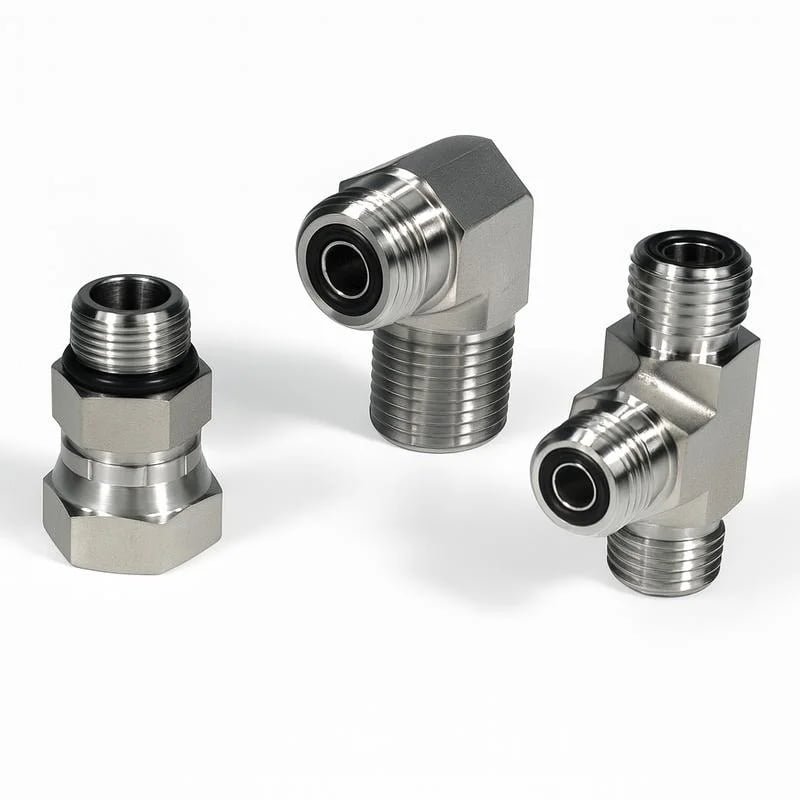
Advanced systems may benefit from NPTF dryseal threads or ORFS fittings depending on leakage and pressure requirements.
NPTF dryseal threads
NPTF reduces leakage without sealant but still relies on thread deformation.
JIC vs AN fittings
AN uses the same 37° flare but tighter aerospace tolerances.
JIC vs ORFS
ORFS uses an O-ring face seal and handles even higher pressure with zero leak tolerance.
System-level thinking
Fittings should match system risk, not just initial cost.
Conclusion
JIC and NPT serve different purposes. Choosing correctly protects safety, reduces leaks, and saves long-term cost.
TITAN Fluid is a leading supplier of stainless steel JIC and NPT Hydraulic Fittings for over 15 years. Contact Us for more details.