If you’ve ever had a hose fitting corrode, leak, or crack at the worst possible time, you already know: not all materials are created equal.
Stainless steel hose fittings significantly outperform carbon steel in harsh environments, but do they justify the cost in every case? The right choice depends on your specific operating conditions.
Let me break it all down. From material science to cost analysis, here’s what I recommend after two decades in the fittings industry.
Why hose end fittings matter in hydraulic and industrial systems?
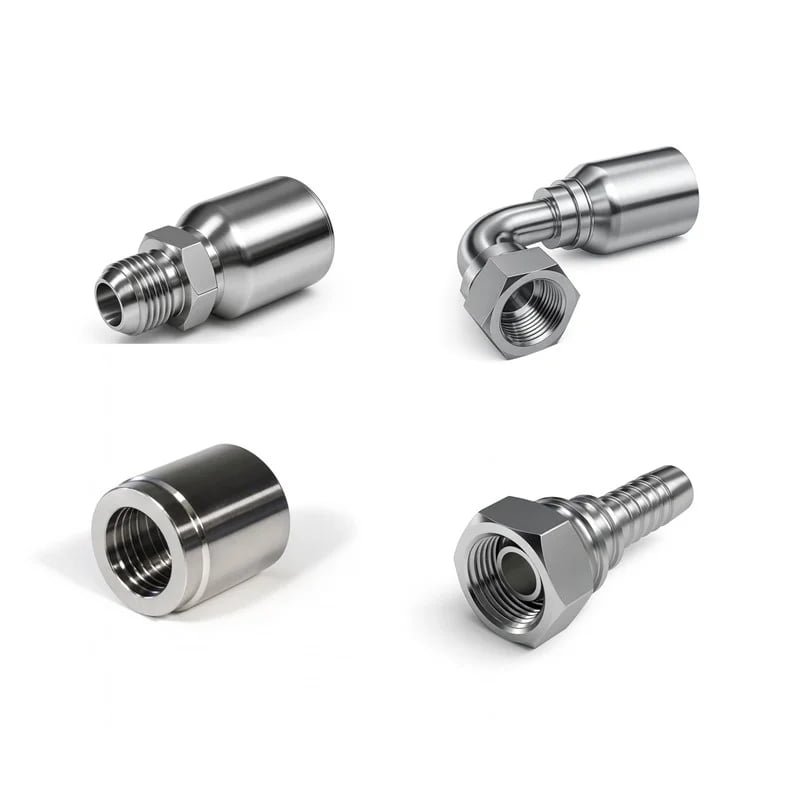
Nobody wants downtime from a failed hydraulic connection. But that’s exactly what happens when fittings crack under pressure, corrode in salty environments, or leak due to thermal stress.
The hose end fitting isn’t just a connector. It’s the weakest point in many hydraulic systems if chosen poorly.
When a fitting fails, the entire system goes down. That can mean safety risks, lost production, and emergency replacements. Material choice isn’t just a preference—it’s an engineering decision with real-world cost implications.
Key Failure Risks from Poor Material Choice:
- Corrosion in marine or chemical environments
- Cracking under cold temperatures
- Thread deformation from high torque or vibration
I’ve seen clients save pennies on fittings, only to pay thousands in repairs. Let’s look at why that happens.
What Is Carbon Steel?
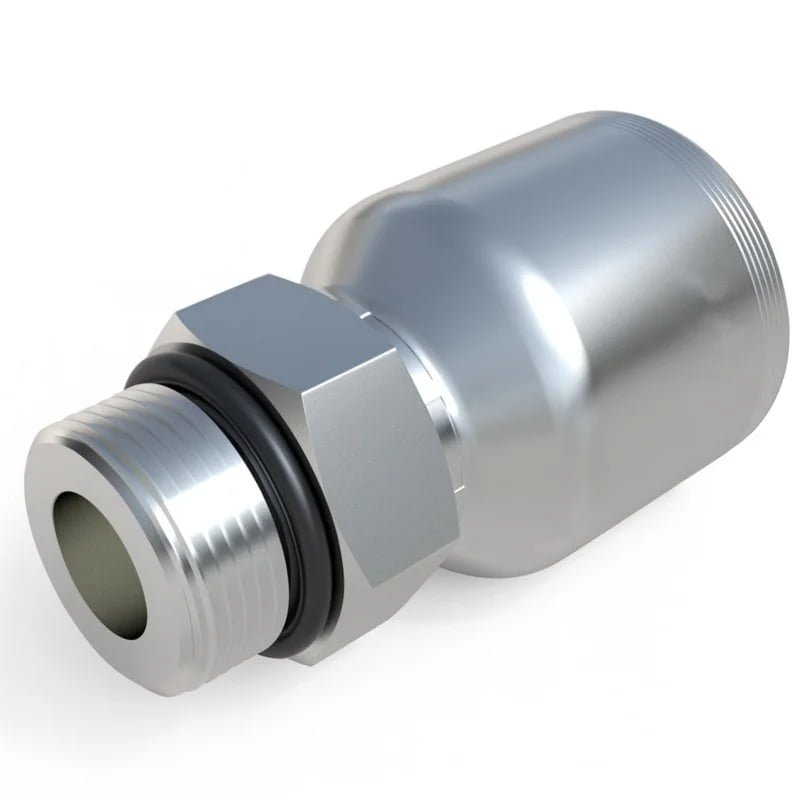
When price is the top concern, carbon steel fittings are often the first choice. But let’s understand what we’re actually getting.
Carbon steel is an iron-carbon alloy that offers good strength but poor corrosion resistance.
Key Characteristics:
- Composition: Primarily iron and 0.05% to 2.1% carbon
- Grades: 1010, 1045, 12L14 (low to medium carbon)
- Tensile Strength: 400–600 MPa
Where Carbon Steel Works:
- Machinery operating in dry environments
- Standard hydraulics (SAE J514 / ISO 8434-2)
Where Carbon Steel Fails:
- Marine systems (saltwater exposure)
- Food or chemical processing (sanitation requirements)
- Outdoor installations with freeze-thaw cycles
Unless you protect it with plating or coatings, carbon steel rusts fast. Which brings us to its alternative.
What Is Stainless Steel?
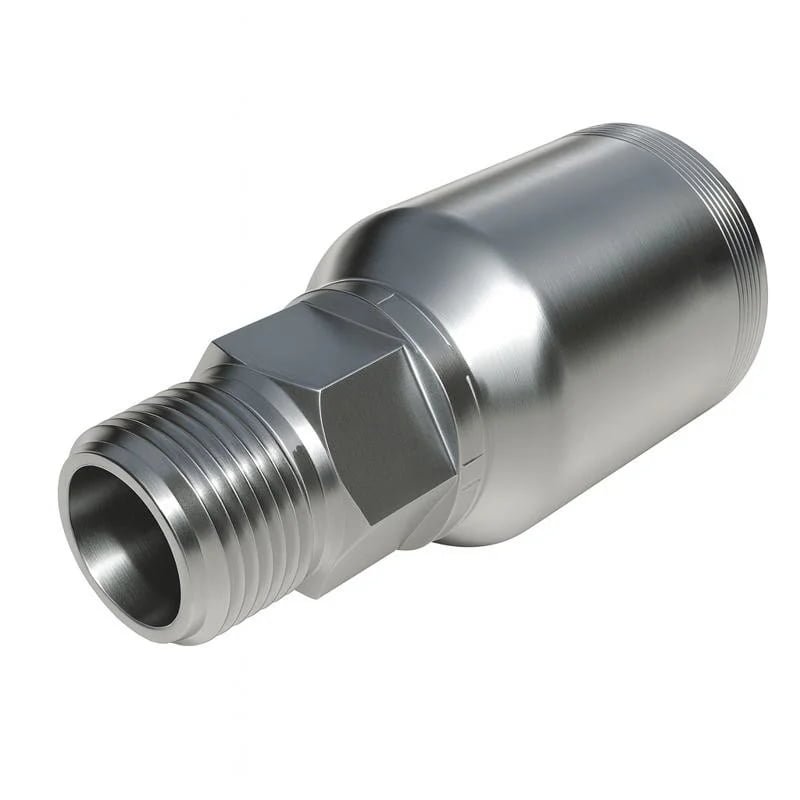
Stainless steel is the gold standard for long-term performance, especially in aggressive or critical applications.
Stainless steel resists corrosion thanks to its chromium content, which forms a passive oxide layer that blocks moisture and oxygen.
Alloy Breakdown:
- SS304: 18% Cr, 8% Ni — general corrosion resistance
- SS316: Adds 2-3% Mo — better in chloride environments
- SS316L: Low carbon version of 316 — reduced risk of intergranular corrosion
Where Stainless Shines:
- Marine and offshore platforms
- Food & beverage systems (FDA-grade)
- Chemical injection or analysis systems
- High-purity or sanitary installations (pharma, biotech)
Lifespan & Maintenance:
- Up to 20+ years without replacement
- Resists scaling, pitting, and chemical attack
- Minimal maintenance (no recoating or repainting)
Yes, it costs more upfront. But it saves money in every other category.
Side-by-Side Material Comparison
| Feature | Carbon Steel | Stainless Steel |
|---|---|---|
| Corrosion Resistance | Low | Very High |
| Strength | Good | Good to High |
| Temperature Resistance | Moderate | Excellent |
| Weight/Size | Heavier | Lighter (thin wall) |
| Cost | Lower upfront | Higher upfront |
For your engineers and purchasing managers, here’s what that means in real-world decision-making.
How to Choose the Right Material?
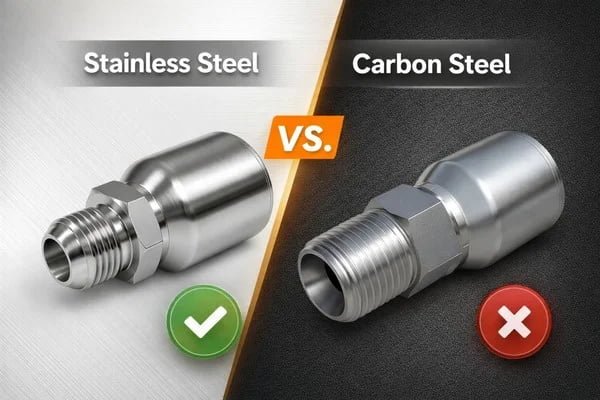
No one material is better in every case. It all depends on where and how you use the fitting.
Use stainless steel when failure isn’t an option. Use carbon steel when budget is tight and conditions are clean.
Ask These Questions:
Environment
- Will the fitting face saltwater, chemicals, or humidity?
- Will it be exposed to outdoor cycles (freeze/thaw, UV)?
Application Requirements
- Is it high-pressure (>4000 psi)?
- Does it involve food, medicine, or cleanroom standards?
- Is vibration or shock likely (mobile systems)?
Cost Over Time
| Cost Category | Carbon Steel | Stainless Steel |
|---|---|---|
| Initial Unit Cost | $$ | $$$ |
| Replacement Frequency | Every 1–3 years | 10–20+ years |
| Downtime Risk | Medium-High | Low |
| Maintenance Needs | Coating, inspection | Minimal |
Use a lifecycle calculator. You’ll find stainless wins over a 5+ year span, especially in critical systems.
Real-World Case Studies
1. Hydraulic System in Cold Climate (Alberta, Canada)
A customer used carbon steel ORFS fittings on snowplows. Replacements were frequent due to rust and cracking. After switching to 316 stainless steel, lifespan improved from 2 years to 10+ years, with no failures.
2. Offshore Rig Use Case
An OEM client working on North Sea rigs needed fittings for 10,000 psi systems with constant saltwater spray. Stainless was the only viable material. All fittings were supplied with EN 10204 3.1 certificates for traceability.
3. Food Processing System
In a dairy processing plant, fittings had to meet hygiene and CIP (clean-in-place) standards. We supplied SS316L fittings that are now NSF compliant, corrosion-proof, and easy to sanitize.
Installation & Maintenance Tips
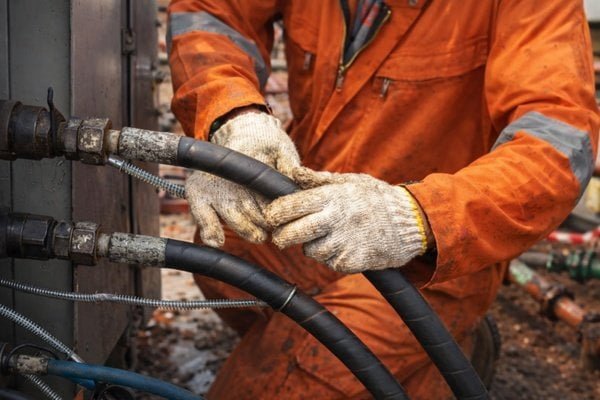
Proper handling extends fitting life, no matter the material.
For Carbon Steel:
- Apply zinc plating or epoxy coatings
- Use thread sealants for added corrosion barrier
- Store in dry, temperature-controlled spaces
For Stainless Steel:
- Avoid contamination during installation (do not use carbon tools)
- Don’t over-tighten—this causes galling
- Use anti-seize compound where needed
Inspection Intervals:
| Fitting Type | Inspection Frequency |
|---|---|
| Carbon Steel | Every 6–12 months |
| Stainless Steel | Every 2–3 years |
Cost Analysis & ROI
Don’t just ask "how much does it cost?" Ask "how long will it last and what will failure cost me?"
Total Cost of Ownership Table
| Category | Carbon Steel | Stainless Steel |
|---|---|---|
| Initial Cost | $10 | $25 |
| Avg. Replacement Time | 2 years | 10+ years |
| Downtime Cost/Failure | $200+ | Minimal |
| Resale/Recycling | Low | High (scrap SS) |
If you’re in a regulated or harsh environment, stainless pays for itself in 2–3 years. For less critical systems, carbon steel works—just plan for more upkeep.
FAQs
Does stainless steel always outperform carbon steel?
No. In dry, indoor, non-corrosive environments, carbon steel may perform adequately.
Can carbon steel be treated to match stainless?
Partially. With proper coatings and controlled use, you can extend carbon steel life. But it’ll never fully match stainless steel in performance.
What fittings for high-pressure systems?
Use stainless steel or zinc-nickel plated carbon steel that meets ISO 8434 / SAE J1453 for ORFS systems.
Conclusion
Choose stainless for performance, carbon for price—but always match the material to the environment and application.
TITAN Fluid is a leading supplier of stainless steel hose fittings for over 15 years. Please contact us more details.