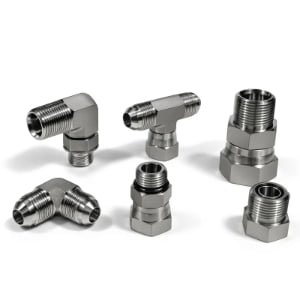
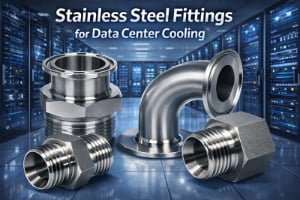
Many buyers confuse BSPP, BSPT, R, and Rc threads. This confusion causes leaks, returns, and warranty claims. One wrong thread choice can damage your reputation.
BSPP is a parallel thread that seals on the face. BSPT is a tapered thread that seals on the threads. R is male tapered, and Rc is female tapered. They follow different sealing logics and are not always interchangeable.
In this guide, I will not just define them. I will explain where sealing actually happens, how stress is distributed, and how to choose correctly for your application.
What Are BSP Threads?
Many buyers use BSP threads daily but do not understand their design logic. This leads to incorrect substitutions and field failures.
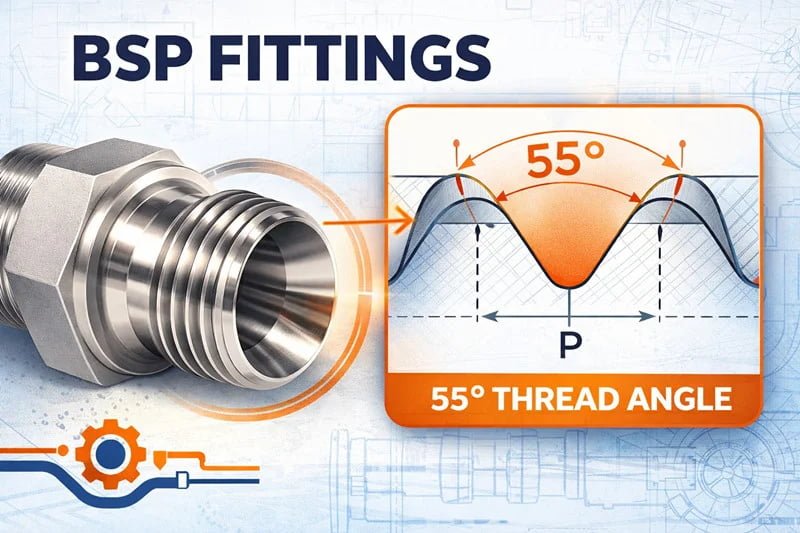
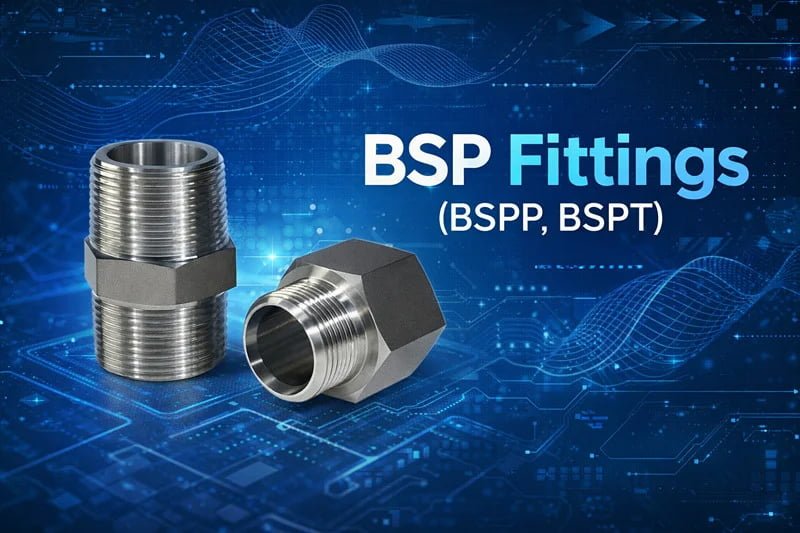
BSP stands for British Standard Pipe. It is a 55° Whitworth thread system that includes both parallel (BSPP) and tapered (BSPT) versions for pipe connections.
Origin of BSP (British Standard Pipe)
BSP originated in the United Kingdom in the 19th century. It was designed to standardize pipe connections in industrial systems.
Today, BSP threads are widely used in:
- Europe
- Asia
- Australia
- Hydraulic and fluid systems
In my 15+ years supplying stainless steel hydraulic fittings, I see BSP threads mostly in OEM equipment exported to the EU and Middle East markets.
The key point is this: BSP is not one single thread type. It is a thread family.
The 55° Whitworth Thread Profile
BSP threads use a 55° thread angle. This differs from NPT, which uses 60°.
The 55° Whitworth profile has:
- Rounded crests
- Rounded roots
- Symmetrical thread geometry
This profile affects how load is distributed under pressure. The rounded shape reduces stress concentration compared to sharp threads.
However, the thread profile itself does not determine sealing. Sealing depends on whether the thread is parallel or tapered.
Parallel vs Tapered Thread Fundamentals
This is where most misunderstandings begin.
There are two fundamental thread geometries:
| Type | Diameter Change | Sealing Location |
|---|---|---|
| Parallel | Constant | Face or O-ring or Bonded Seal |
| Tapered | Reduces along length | Thread interference |
Parallel threads do not seal on the threads.
Tapered threads seal because the male and female threads wedge together.
If you remember only one thing:
Thread geometry determines sealing logic.
What Is BSPP (Parallel Thread)?
Many buyers assume all pipe threads seal the same way. That is wrong and dangerous.
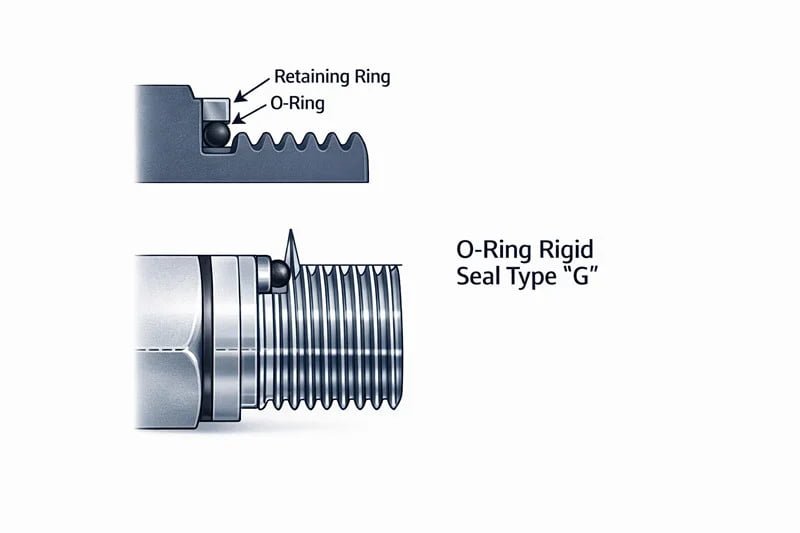
BSPP is a parallel thread (constant diameter) that seals through a face seal, bonded washer, or O-ring. The threads only provide mechanical engagement, not sealing.
Thread Geometry and Profile
BSPP threads:
- 55° Whitworth profile
- Parallel diameter
- No taper
Because there is no taper, tightening does not create radial compression between threads.
This means there is no thread interference seal.
The thread only holds the fitting in place.
Sealing Method (O-Ring, Washer, Face Seal)
The sealing happens here:
- Bonded seal washer under hex
- O-ring in groove
- Flat face compression
This is called face sealing.
Why Face Sealing Is Superior in Many Cases
Face sealing provides:
- Controlled compression
- Repeatable torque
- No thread damage
- Better reusability
The stress is axial, not radial.
This reduces port cracking in stainless steel manifolds.
In high-end hydraulic systems, I recommend BSPP with O-ring whenever possible.
Standards Reference (ISO 228)
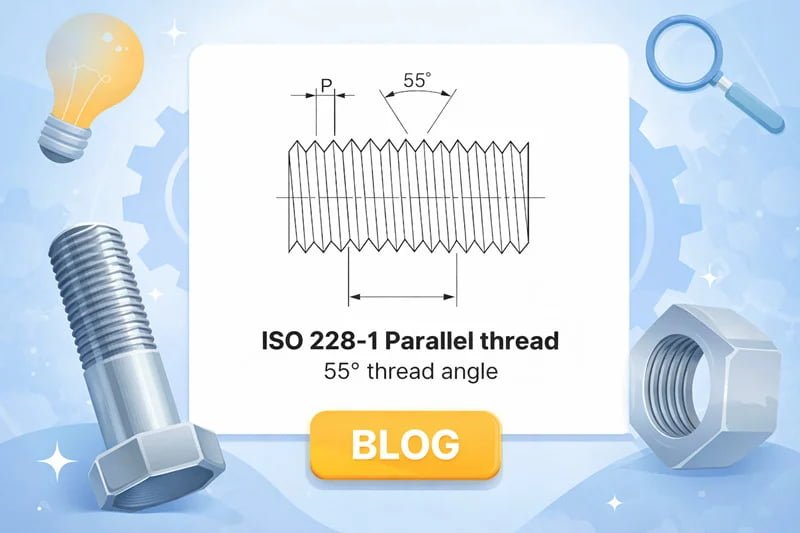
BSPP threads follow ISO 228.
Key feature of ISO 228:
- Threads do not provide pressure-tight joint
- Sealing must occur externally
This is very important when you audit suppliers.
Common Applications
BSPP is common in:
- Hydraulic adapters
- Instrumentation fittings
- Manifolds
- Quick disconnect ports
Many BSPP versions use O-ring face sealing because it improves leak reliability.
What Is BSPT?
Some buyers treat BSPT as interchangeable with BSPP. That mistake creates leaks immediately.
BSPT is a tapered thread that seals by thread interference. The male thread tapers and wedges into the female thread to create radial sealing pressure.
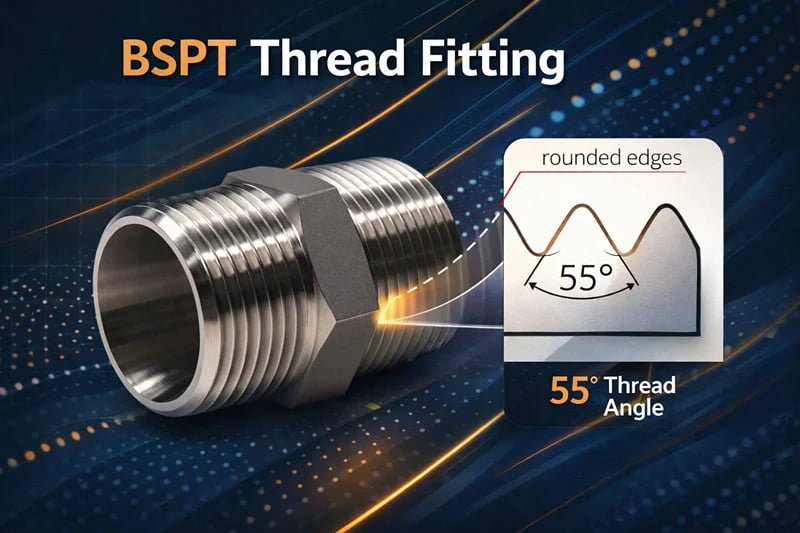
Taper Design and Function
BSPT threads taper at 1:16.
As the male thread enters:
- The diameter increases
- Radial compression builds
- Contact pressure increases
This creates the seal.
The sealing is inside the threads.
Sealing by Thread Interference
The seal forms because:
- Metal contacts metal
- Or thread sealant fills micro gaps
The stress distribution is radial.
This means:
- Over-tightening increases hoop stress
- Thin ports may crack
- Stainless steel threads may gall
This is why torque control is critical.
ISO 7-1 Standard
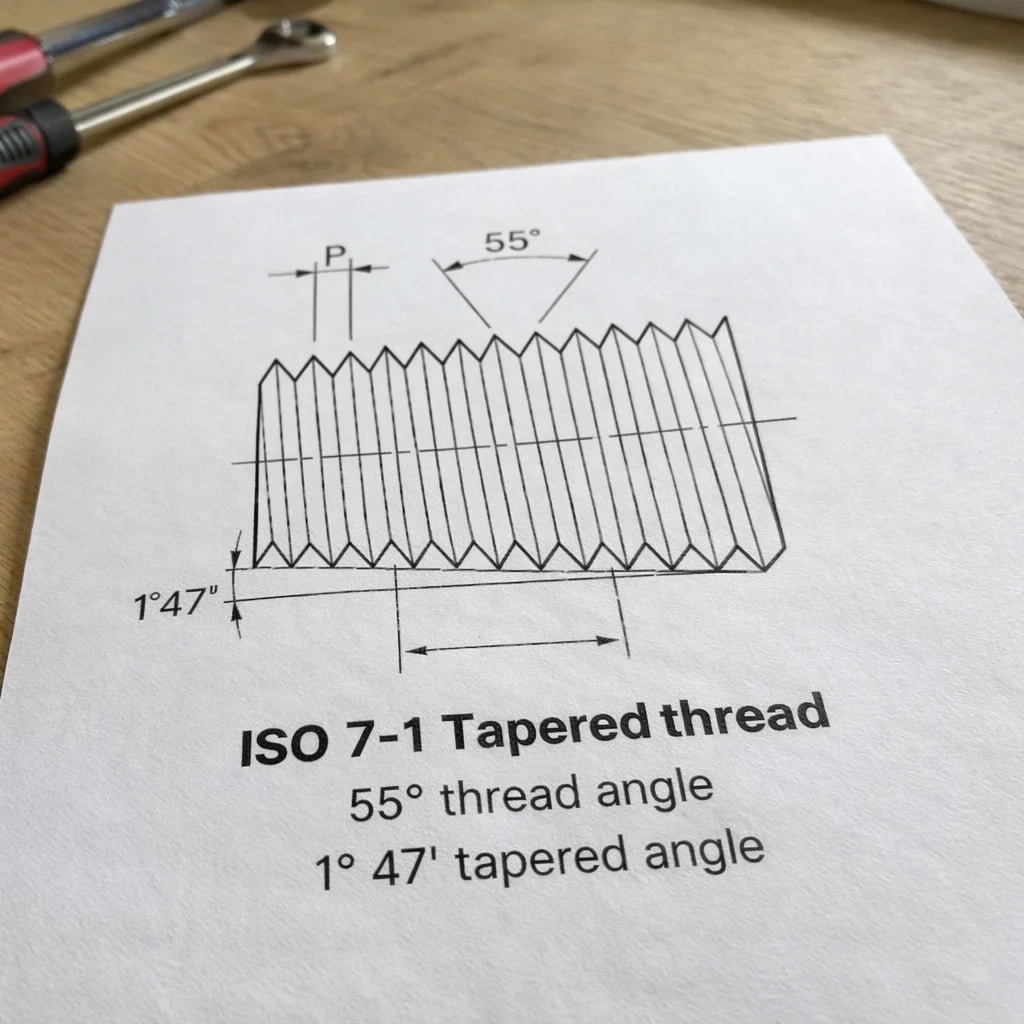
BSPT follows ISO 7-1.
Unlike ISO 228 (BSPP), ISO 7-1 allows threads to seal pressure directly.
This difference defines the whole system logic.
Industrial Use Cases
BSPT is common in:
- Water systems
- Pneumatics
- Low to medium pressure lines
- Pipe connections
Tapered thread logic is widely used in pipe systems where face sealing is not available.
What Is R and Rc Thread?
Many catalogs list R and Rc without explanation. Buyers often misunderstand them.
R is a male tapered BSPT thread. Rc is a female tapered BSPT thread. Both follow ISO 7-1 and seal through taper interference.
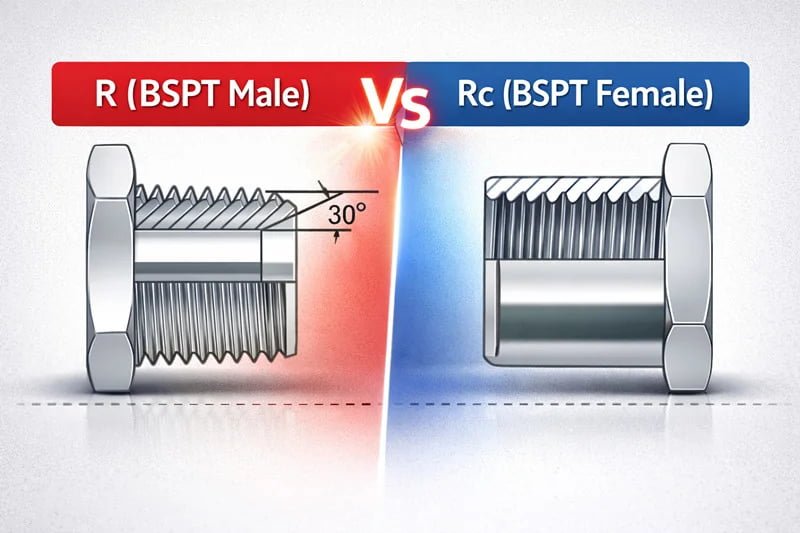
R Thread (External Tapered Male)
R thread:
- External tapered
- Seals when tightened into Rc or Rp
- Requires sealant in many cases
It is essentially BSPT male.
Rc Thread (Internal Tapered Female)
Rc thread:
- Internal tapered
- Designed to mate with R
- Forms interference seal
Rc is not parallel.
This is where confusion happens.
Why R and Rc Are Designated Differently
Because:
- R = external tapered
- Rc = internal tapered
- Rp = internal parallel
Each has different compatibility rules.
Without knowing this, buyers mix wrong parts.
Compatibility Rules
| Male | Female | Safe? |
|---|---|---|
| R | Rc | Yes |
| R | Rp | Conditional |
| BSPP | Rc | No |
Always verify before mass production.
BSPP vs BSPT vs R vs Rc – Direct Comparison Table
| Thread Type | Taper/Parallel | Male/Female | Sealing Mechanism | Standard | Interchangeability |
|---|---|---|---|---|---|
| BSPP | Parallel | Both | Face seal / O-ring | ISO 228 | Not with BSPT |
| BSPT | Tapered | Both | Thread interference | ISO 7-1 | With R/Rc |
| R | Tapered | Male | Thread interference | ISO 7-1 | With Rc |
| Rc | Tapered | Female | Thread interference | ISO 7-1 | With R |
Can BSPP, BSPT, R, and Rc Be Used Together?
Many buyers try to reduce SKU numbers by mixing them. This can be risky.
Some combinations are safe. Others cause immediate leaks or stress damage.
Safe Combinations
- R male + Rc female
- BSPP + BSPP with washer
- BSPP + port O-ring design
These maintain sealing logic consistency.
Unsafe Combinations
- BSPP into Rc
- R into BSPP port without seal
- Mixing taper without sealant
Parallel thread into tapered port will never seal properly.
Adapter Solutions
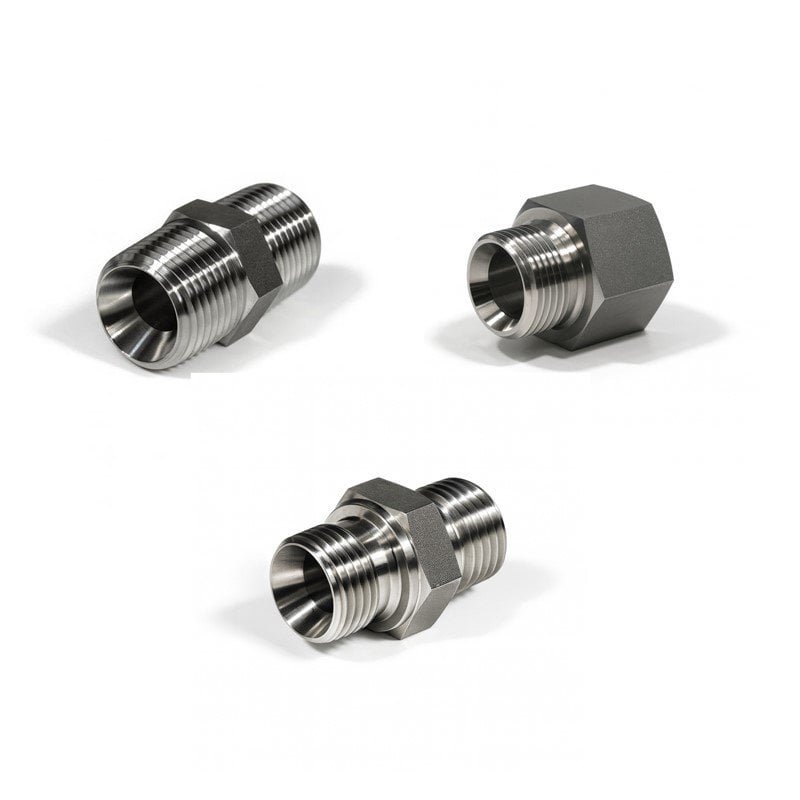
The safe solution is:
Use stainless steel adapters designed for conversion.
Adapters protect your OEM reputation and avoid field modification.
How to Identify BSP Thread Types in the Field
Field identification prevents costly errors.
You must measure diameter, check taper, and count thread pitch before ordering.
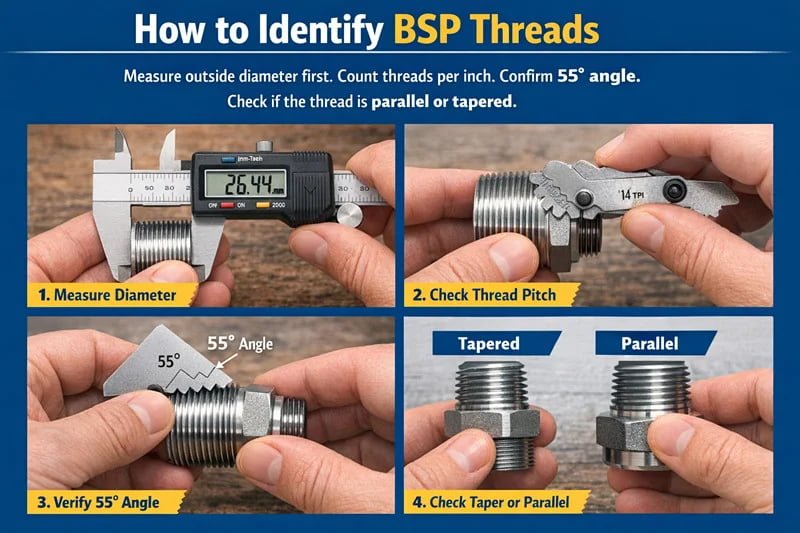
Measuring Thread Diameter
Measure outer diameter for male threads.
If diameter reduces along thread length, it is tapered.
Checking Thread Taper
Use calipers at:
- First thread
- Last thread
If diameter changes, it is BSPT/R/Rc.
Common BSPP (G) Thread Pitch Reference Table (Complete Version)
Below is a more complete BSPP (G thread, ISO 228) pitch reference list for common sizes.
| BSPP Size (G) | Nominal Size (inch) | Threads Per Inch (TPI) | Pitch (mm) |
|---|---|---|---|
| G1/16 | 1/16" | 28 TPI | 0.907 mm |
| G1/8 | 1/8" | 28 TPI | 0.907 mm |
| G1/4 | 1/4" | 19 TPI | 1.337 mm |
| G3/8 | 3/8" | 19 TPI | 1.337 mm |
| G1/2 | 1/2" | 14 TPI | 1.814 mm |
| G5/8 | 5/8" | 14 TPI | 1.814 mm |
| G3/4 | 3/4" | 14 TPI | 1.814 mm |
| G7/8 | 7/8" | 14 TPI | 1.814 mm |
| G1 | 1" | 11 TPI | 2.309 mm |
| G1-1/4 | 1-1/4" | 11 TPI | 2.309 mm |
| G1-1/2 | 1-1/2" | 11 TPI | 2.309 mm |
| G2 | 2" | 11 TPI | 2.309 mm |
Important Technical Notes
- BSPP and BSPT share the same pitch at the same nominal size.
- G thread = BSPP (parallel).
- R / Rc thread = BSPT (tapered).
- Pitch does not determine sealing type. Geometry does.
Practical Identification Tip
If you measure:
- 19 TPI → It is likely G1/4 or G3/8
- 14 TPI → It is likely G1/2, G3/4, or G7/8
- 11 TPI → It is likely G1 and above
But you must still check:
- Major diameter
- Whether the thread is tapered or parallel
Pitch alone is not enough to confirm thread type.
Tools Required
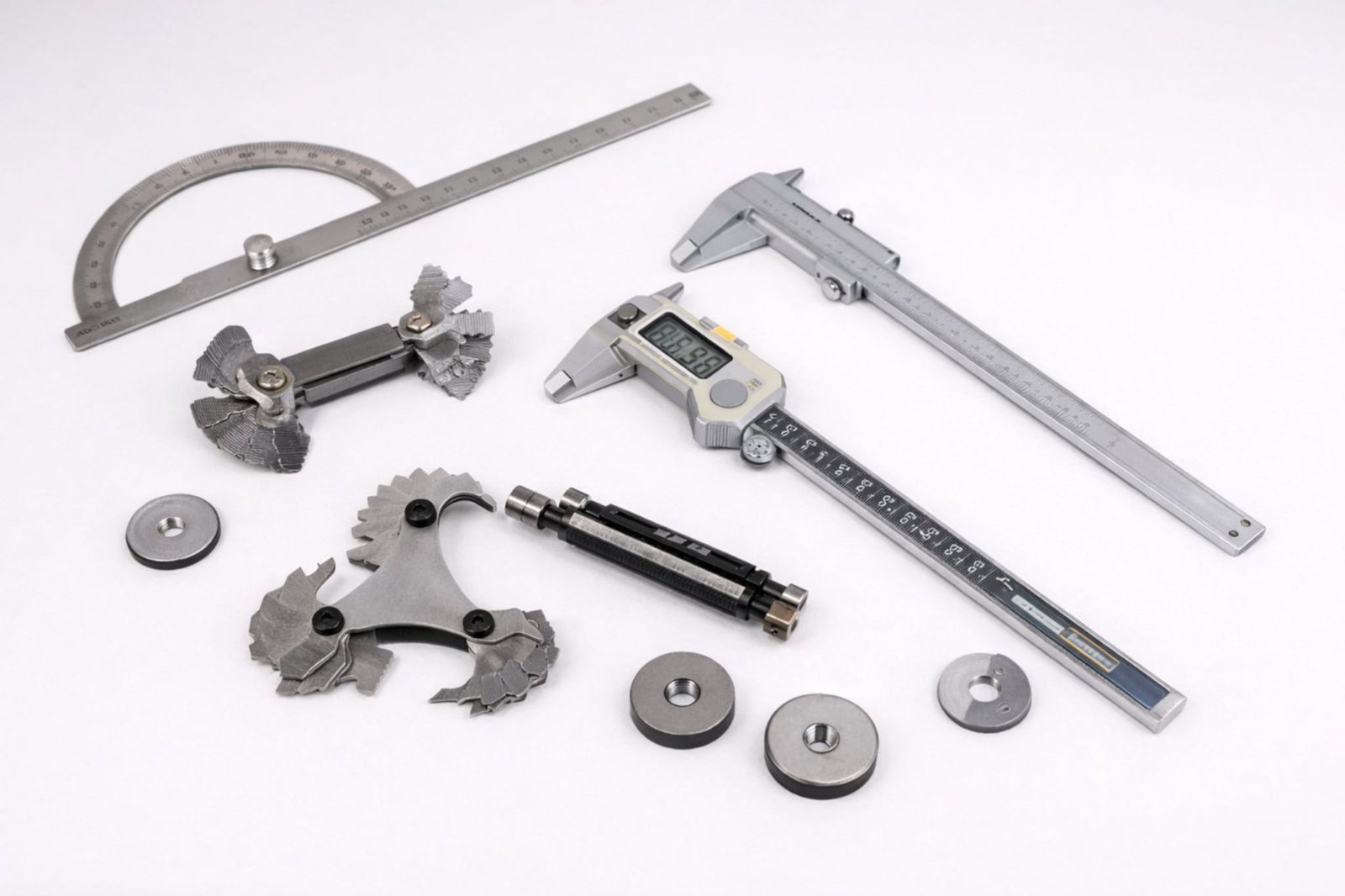
- Vernier caliper
- Thread pitch gauge
- Visual inspection
Simple tools prevent expensive returns.
Common Mistakes When Selecting BSP Threads
I see these mistakes every year.
Most failures happen because buyers misunderstand sealing logic.
Assuming R = BSPP
R is tapered.
BSPP is parallel.
They are not the same.
Ignoring Seal Method
Thread shape is not sealing method.
You must ask:
Where does sealing occur?
Mixing Parallel and Tapered
Parallel into tapered port will:
- Leak
- Damage threads
- Crack ports
Over-tightening Tapered Threads
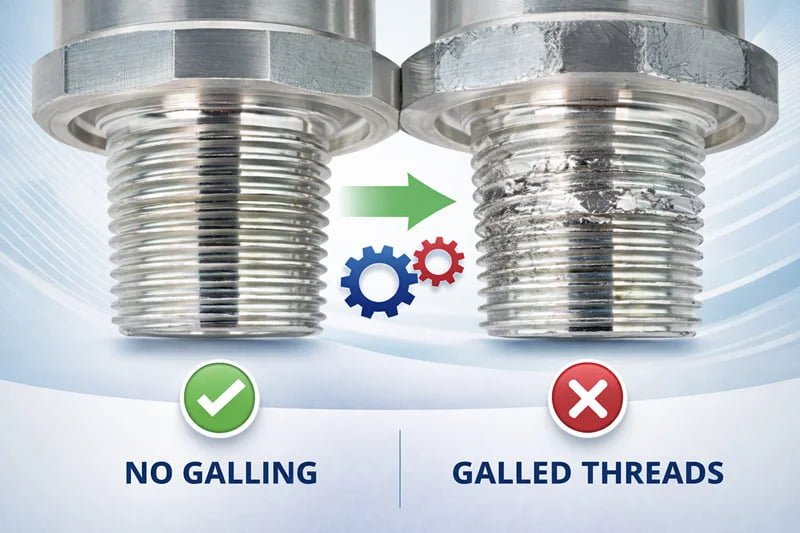
Too much torque causes:
- Radial stress
- Port expansion
- Stainless cracking
Control torque carefully.
Which Thread Type Should You Choose?
Buyers often ask me this question.
Choose based on pressure, maintenance frequency, reusability, and sealing reliability.
Pressure
High pressure → Prefer BSPP with O-ring
Low pressure → BSPT acceptable
Maintenance
Frequent disassembly → BSPP better
Permanent pipe → BSPT acceptable
Reusability
BSPP allows repeated use.
BSPT deforms threads over time.
Sealing Reliability
O-ring face seal is more controlled.
Thread interference depends on torque and sealant.
For stainless steel hydraulic systems, I generally recommend BSPP with O-ring whenever design allows.
Final Technical Summary
- BSPP = parallel, face seal
- BSPT = tapered
- R = male tapered
- Rc = female tapered
- Sealing logic determines performance
Understanding sealing mechanics protects your system and your brand reputation.
TITAN Fluid is a leading supplier of stainless steel BSP fittings for over 15 years. Please contact us for more details.