Many buyers confuse BSPP Class A and Class B threads. That confusion causes leaks, inspection failures, and rejected shipments.
BSPP Class A and Class B define different manufacturing tolerance grades for parallel British pipe threads. Class A typically applies to external threads with tighter tolerance, while Class B commonly applies to internal threads with standard tolerance. The difference affects fit, inspection, and sealing reliability.
I have seen projects delayed simply because the tolerance class was not specified on a drawing. So let me break this down clearly from an engineering and sourcing perspective.
What Are BSPP Threads?
Many engineers use BSPP threads daily, but many purchasing managers do not fully understand how they seal or why tolerance matters.
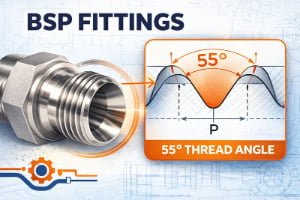
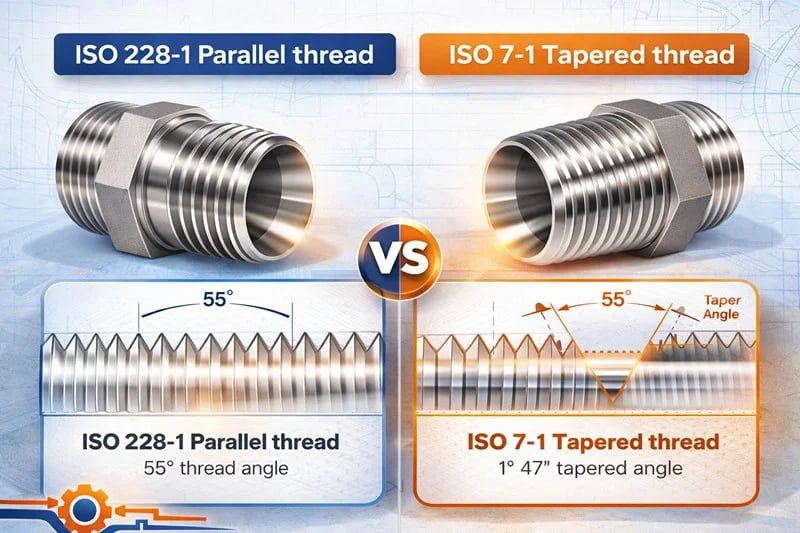
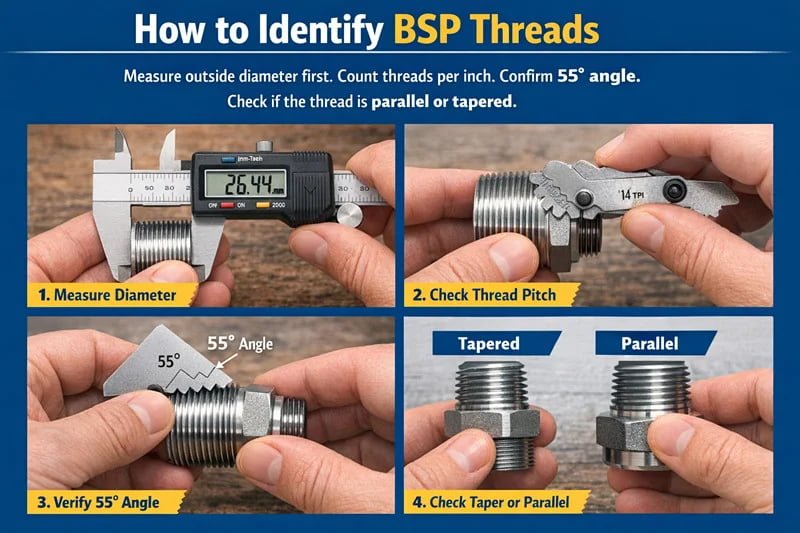
BSPP stands for British Standard Pipe Parallel. It is a straight (parallel) thread with a 55° Whitworth profile, defined under ISO 228-1, and it does not seal on the threads themselves.
Definition of BSPP (British Standard Pipe Parallel)
BSPP threads are parallel threads. The diameter stays constant along the thread length. Unlike tapered threads, they do not create sealing through thread interference.
BSPP threads are defined under ISO 228-1. The thread form is based on the Whitworth 55° angle. That angle is different from 60° metric or UN threads.
In our stainless steel hydraulic adapters, we machine BSPP ports according to ISO 228-1 requirements. The port face must be perpendicular to the thread pitch diameter and free of tool marks.
Thread Angle (55° Whitworth Form)
The 55° thread angle is critical. It defines:
- Crest radius
- Root radius
- Thread depth
- Load distribution
If a supplier cuts it incorrectly, you may still screw the fitting in. But you will see:
- Uneven load distribution
- Higher wear
- Early leakage under vibration
Parallel vs Tapered Comparison
Here is a simplified comparison:
| Feature | BSPP (Parallel) | BSPT (Tapered) |
|---|---|---|
| Thread Type | Straight | Tapered |
| Sealing Method | O-ring / washer | Thread interference |
| Reusability | High | Limited |
| Inspection | Gauge-based | Gauge + torque dependent |
BSPP does not seal through threads. It seals through:
- Bonded seal
- O-ring
- Face seal
Relevant Standard (ISO 228-1)
ISO 228-1 defines:
- Thread dimensions
- Pitch diameter
- Tolerance zones
- Gauge requirements
Tolerance classes (like Class A and Class B) define how much deviation is allowed during manufacturing.
That leads us to the key question.
What Do “Class A” and “Class B” Mean?
Many buyers assume Class A is “better” and Class B is “lower quality.” That is not correct.
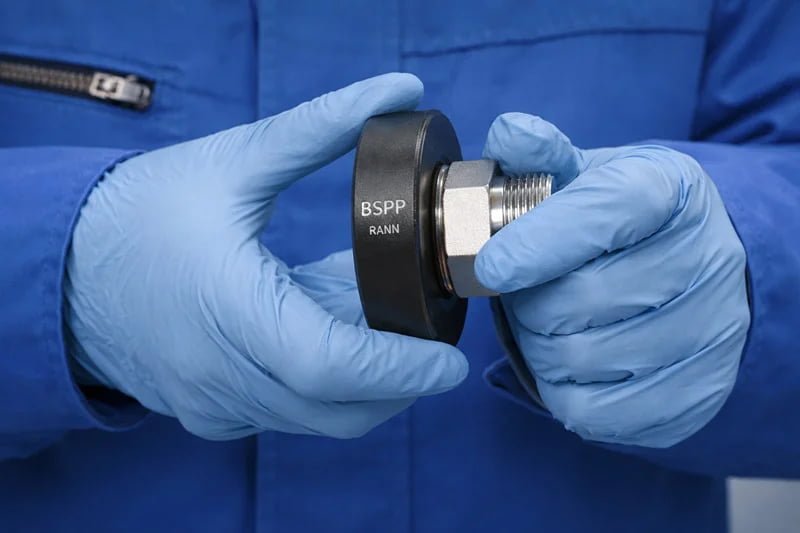
Class A and Class B are manufacturing tolerance grades. They define how tight the thread dimensions must be controlled. They do not change thread type or sealing method.
Manufacturing Tolerance Grades
Tolerance class controls:
- Major diameter deviation
- Pitch diameter deviation
- Minor diameter limits
- Thread engagement allowance
Class A typically has tighter tolerance limits than Class B.
Tighter tolerance means:
- More precise machining
- Better control of pitch diameter
- Less clearance
But tighter tolerance also means:
- Higher machining cost
- More frequent gauge rejection
- Higher scrap rate
Internal vs External Thread Classification
In many specifications:
- External threads → Class A for most of European countries(Class B is available for Asian countries, but less common)
- Internal threads → Class B
This pairing ensures controlled engagement without excessive interference.
If both sides are too tight, assembly becomes difficult. If both are too loose, sealing components carry excessive load.
Why Tolerance Classes Exist
Tolerance classes exist because manufacturing is not perfect.
Every machining process has:
- Tool wear
- Temperature variation
- Material deformation
Tolerance classes define acceptable deviation ranges.
Inspection uses:
- GO gauge
- NO-GO gauge
- Pitch diameter measurement
If the thread fails gauge inspection, it must be rejected. For OEM projects in Europe, this is non-negotiable.
Class A vs Class B — Detailed Technical Comparison
Tolerance differences directly affect fit, load distribution, and long-term performance.
Class A threads have tighter dimensional control than Class B threads. This results in reduced clearance, better alignment, and more predictable engagement under pressure.
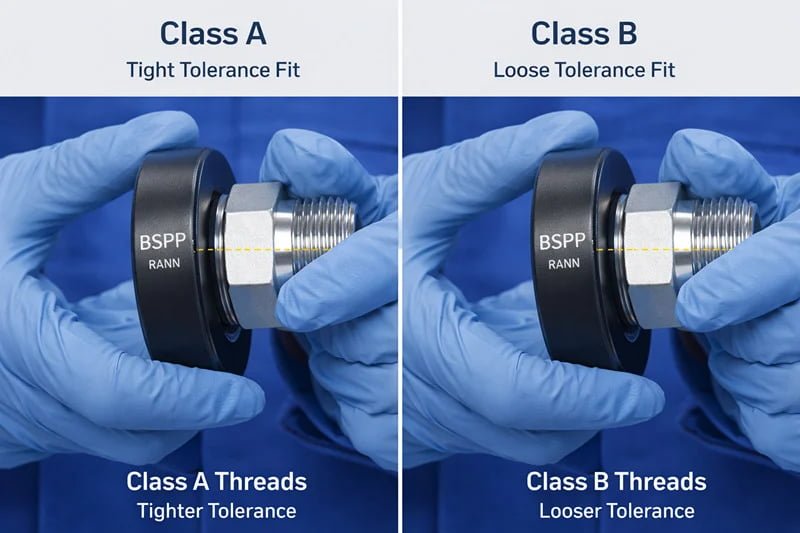
Tolerance Differences
Class A external threads usually have:
- Smaller pitch diameter variation
- Reduced major diameter deviation
Class B internal threads allow slightly larger deviation.
That difference affects radial clearance.
Fit and Engagement
Engagement is defined by:
- Pitch diameter overlap
- Thread flank contact
- Axial load transfer
If clearance is too large:
- Thread tilting increases
- O-ring compression becomes uneven
- Vibration loosens connection
If clearance is too small:
- Galling risk increases
- Stainless steel seizure risk rises
- Assembly torque increases
Pressure Performance Implications
BSPP does not seal via thread interference. But tolerance still affects:
- O-ring compression alignment
- Face seal stability
- Load distribution under pressure
If threads allow misalignment, the sealing washer carries uneven load.
In stainless steel fittings, misalignment combined with vibration often leads to micro-leakage.
Interchangeability Considerations
Most Class A and Class B combinations are designed to work together.
However:
- Class A external + Class B internal → standard pairing
- Class A + Class A → possible tight fit
- Class B + Class B → higher clearance
Here is a structured comparison:
| Parameter | Class A | Class B |
|---|---|---|
| Tolerance Control | Tighter | Standard |
| Common Usage | External threads | Internal threads |
| Machining Cost | Higher | Lower |
| Assembly Feel | Snug | Normal |
| Risk of Galling | Slightly higher (if dry) | Lower |
| Gauge Rejection Rate | Higher | Lower |
In our stainless steel hydraulic adapters, we always confirm tolerance class before mass production.
Real-World Applications
Tolerance choice depends heavily on application.
Hydraulic Systems
High-pressure hydraulic systems demand:
- Precise alignment
- Controlled torque
- Reliable sealing
In these systems, tighter tolerance improves repeatability.
Industrial Machinery
Industrial machinery may prioritize:
- Faster assembly
- Lower cost
- High interchangeability
In this case, Class B internal threads are common.
OEM Manufacturing
Major OEMs in Europe often require:
- Drawing-specified tolerance class
- Inspection report
- Traceable gauge records
If tolerance class is not respected, parts are rejected.
Export and Compliance Requirements
For export to EU markets:
- Documentation must match drawing
- EN10204 3.1 certificate must be authentic
- Gauge inspection must be recorded
Tolerance class mismatch often causes customs inspection issues.
What Happens If You Use the Wrong Class?
Many buyers underestimate this risk.
Using the wrong BSPP tolerance class can cause leakage, thread damage, inspection failure, and even warranty disputes.
Leakage Risks
Loose tolerance can cause:
- O-ring misalignment
- Face seal tilting
- Uneven compression
Result: micro-leaks under pressure cycling.
Thread Damage
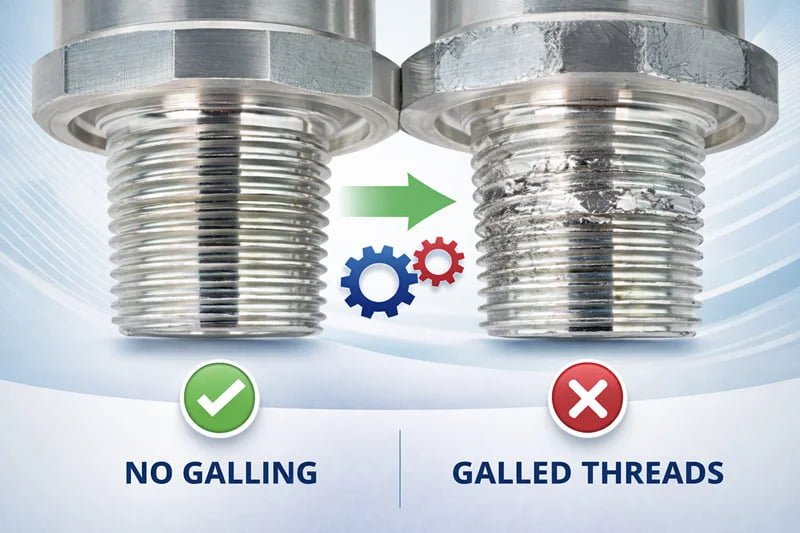
Too tight fit may cause:
- Galling
- Stainless steel seizure
- Permanent thread damage
This is common when lubrication is insufficient.
Inspection Rejection
If drawing specifies Class A external thread and supplier produces Class B:
- Gauge fails
- Parts rejected
- Delivery delayed
I have seen entire containers rejected for this reason.
Warranty Implications
OEM warranty claims often require:
- Dimensional inspection records
- Tolerance verification
Wrong class means no protection during claim.
How to Choose the Right BSPP Class (Decision Guide)
Choosing the correct tolerance is not about “better.” It is about suitability.
You should select BSPP tolerance class based on pressure level, regulatory requirements, machining capability, and supplier quality control.
Application Pressure Level
High pressure → tighter control recommended.
Low pressure → standard tolerance acceptable.
Regulatory Requirements
European OEM drawings often specify tolerance explicitly.
Always follow drawing. Never assume.
Manufacturing Precision Needs
If assembly environment is automated, tighter tolerance improves repeatability.
If field assembly dominates, balanced tolerance may be safer.
Supplier Capability
Ask your supplier:
- What gauges do you use?
- Are gauges calibrated?
- Do you provide inspection report?
Tolerance control is meaningless without inspection discipline.
Frequently Asked Questions
Are Class A and Class B interchangeable?
They are designed to work together, but mixing without understanding tolerance stack-up can cause fit issues.
Is Class A tighter tolerance?
Yes. Class A generally has tighter dimensional control.
Which is more common in Europe?
Standard pairing of Class A external and Class B internal is common in European hydraulic applications.
Does tolerance affect sealing?
Yes. Although BSPP seals with O-ring or washer, tolerance affects alignment and compression uniformity.
Summary: Key Differences at a Glance
- BSPP is a 55° parallel thread under ISO 228-1
- Class A = tighter tolerance, commonly external threads
- Class B = standard tolerance, commonly internal threads
- Tolerance affects fit, alignment, and sealing stability
- Wrong class can cause leakage and inspection rejection
Understanding tolerance is not optional. It is part of engineering responsibility.
TITAN Fluid is a leading supplier of stainless steel BSP fittings for over 15 years. Please contact us for more information.